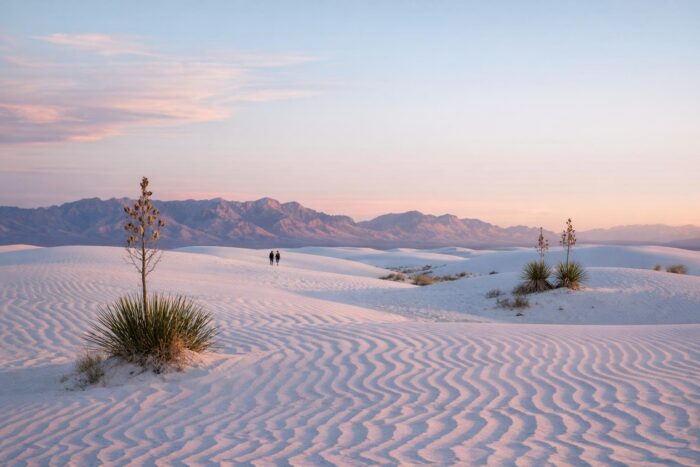
White Sands National Park in southern New Mexico protects part of the largest gypsum dunefield on Earth, a sea of brilliant white sand that covers about 275 square miles of the Tularosa Basin. The park holds about 115 square miles of it, and a single road, Dunes Drive, takes you straight into the heart of the dunes.
It is an easy park to visit in a few hours, but it has one quirk no other park shares: it sits next to a missile range and can close without much warning. Here is how to drive it, how to sled it, how to plan around closures and when the light is best.
White Sands National Park at a glance
| Item | Details |
|---|---|
| Location | Tularosa Basin, New Mexico, about 15 miles from Alamogordo and 52 miles from Las Cruces |
| Status | National monument from 1933, national park since December 20, 2019 |
| Entrance fee | $25 per private vehicle, valid 7 days |
| Park annual pass | $45, sold only at the entrance station |
| Main road | Dunes Drive, 8 miles each way from the visitor center |
| Weather | Sunny about 330 days a year, summer highs around 97°F |
Driving Dunes Drive
Dunes Drive leaves the visitor center and runs 8 miles into the dunefield, ending in a loop. The first stretch is paved and passes through sparse dunes with desert plants. Farther in, the pavement gives way to hard-packed gypsum, the dunes get taller and the plants disappear. Standard cars handle it fine at a slow speed, but expect a plowed, white road that feels a lot like driving on packed snow.
Plan two to four hours for the drive, a short walk and some sledding. Pullouts and parking areas along the way give access to trails and picnic shelters:
- Interdune Boardwalk, a short, flat, accessible walk with signs on how the dunes formed. Sledding is not allowed around it.
- Dune Life Nature Trail, a loop with more climbing on soft sand.
- Alkali Flat Trail, the longest and most demanding hike, across open dunes marked only by posts. Do not start it in the heat of the day.
Every trail in the dunes is exposed, with no shade. Carry more water than you think you need and follow the marker posts closely, since wind can erase footprints quickly.
Sledding on the dunes
Sledding is the classic White Sands activity, and the park encourages it with a few safety rules. Waxed plastic snow saucers work best. You can buy or rent them at the park’s gift shop, or bring your own.
- Pick a dune with a gentle slope and a flat run-out at the bottom.
- Stay well away from the road, parking areas, vegetation and hard clumps of sand.
- Sit or lie with your feet pointing downhill. Never sled head first or standing up.
- Watch the base of the dune, where the sand can be very hard. Injuries are common there.
- Supervise young children closely. Kids aged 5 to 9 are the most likely to get hurt.
Missile range closures
The park is surrounded by White Sands Missile Range, and testing on the range occasionally closes the park. During a test that requires a closure, Dunes Drive shuts for up to three hours, and all activity in the dunes stops: no driving, hiking or sledding.
The park is usually notified about two weeks ahead, but notice can be as short as 24 hours. Before you drive out, check the park’s closure page, and build some flexibility into your day. If you are passing through on a longer road trip, staying a night in Alamogordo gives you a second chance if your first window is closed.
Best time of day to visit
The light makes the visit. At midday, the white sand is blinding and the dunes look flat; in summer it is also hot, with average highs near 97°F. Early morning and the last two hours before sunset are far better:
- Sunset: the dunes turn soft pink and blue and the shadows show every ripple. This is the most popular time, so arrive early enough to find parking.
- Morning: cool sand, few people and animal tracks from the night still visible.
- Season: spring and fall are the most comfortable. Most of the rain falls in the monsoon season, from early July to mid-October, often as afternoon storms.
Park hours vary by season, so check the closing time before you plan a sunset walk deep into the dunes.
White Sands on a Southwest park loop
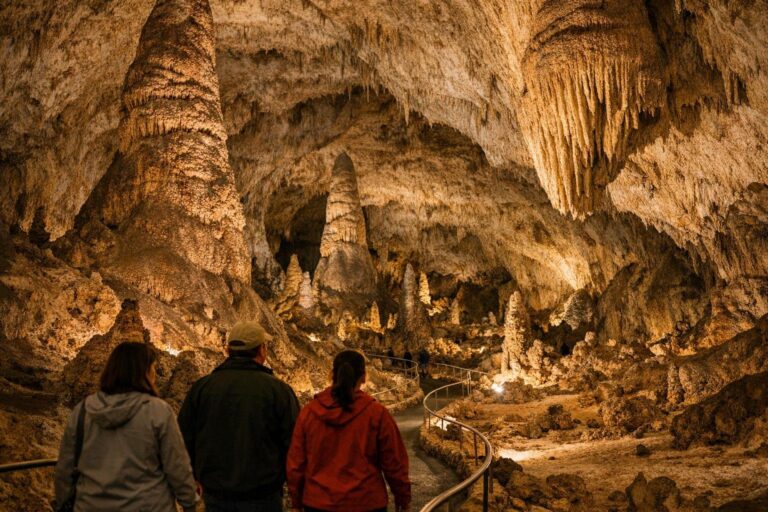
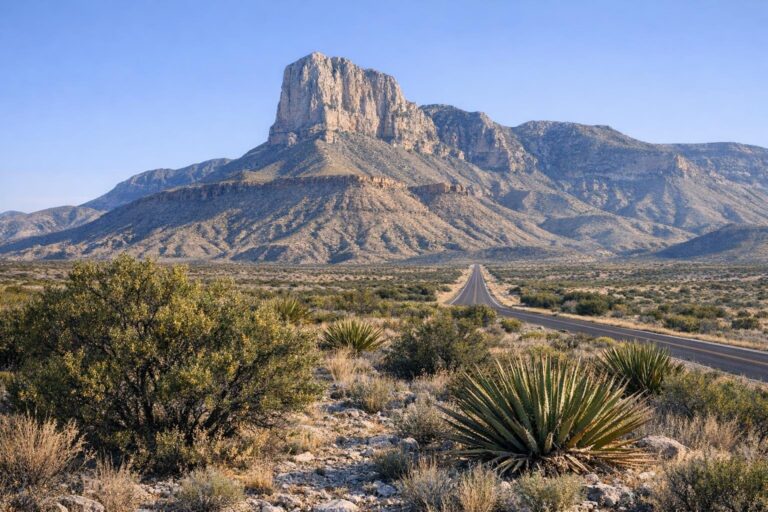
White Sands works well as the western end of a desert loop through Texas and New Mexico. To the southeast, Big Bend National Park offers the Rio Grande canyons and the Chisos Mountains, with the Guadalupe Mountains and Carlsbad Caverns in between. A loop of about a week connects all four, and late October through April keeps the driving and hiking comfortable.
For a wider view of which parks deserve a place on your list, our guide to the top U.S. parks by region covers the Southwest alongside the Rockies, California and the East.
White Sands National Park FAQ
How much does it cost to visit White Sands?
$25 per private vehicle, valid for seven days. Visitors on foot or by bike pay $15 per person, and children under 16 are free.
Can you sled at White Sands?
Yes. Waxed plastic saucers work best, and they are sold or rented at the park’s gift shop.
Why does White Sands close?
Missile tests on the neighboring White Sands Missile Range can close Dunes Drive for up to three hours. Check the park’s closure page before you go.
What is the best time to visit White Sands?
Late afternoon into sunset, or early morning, in spring or fall.