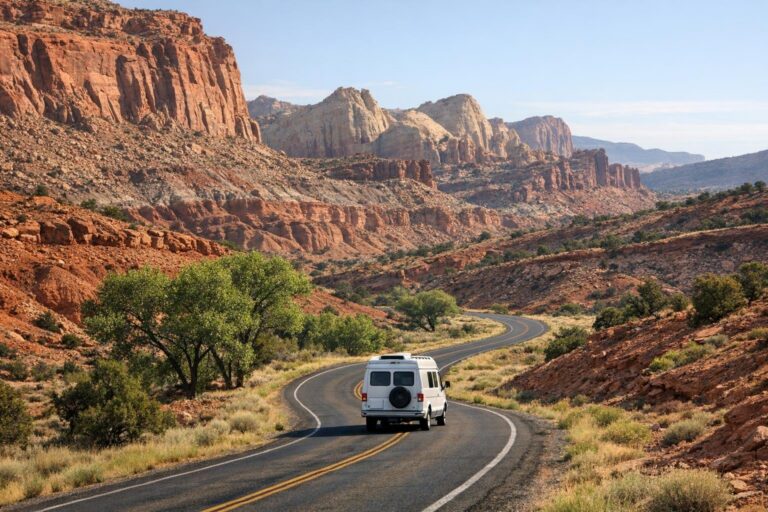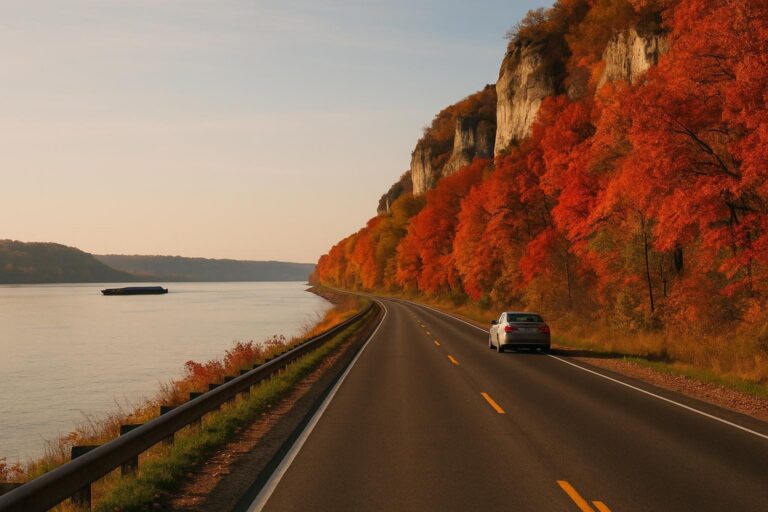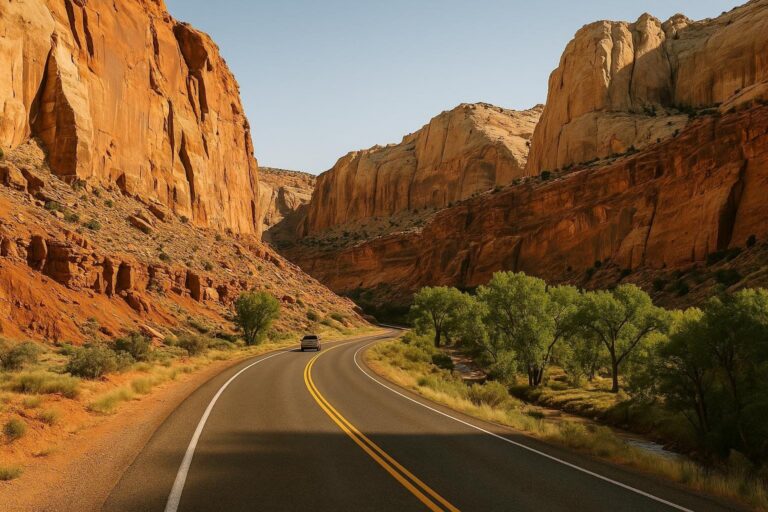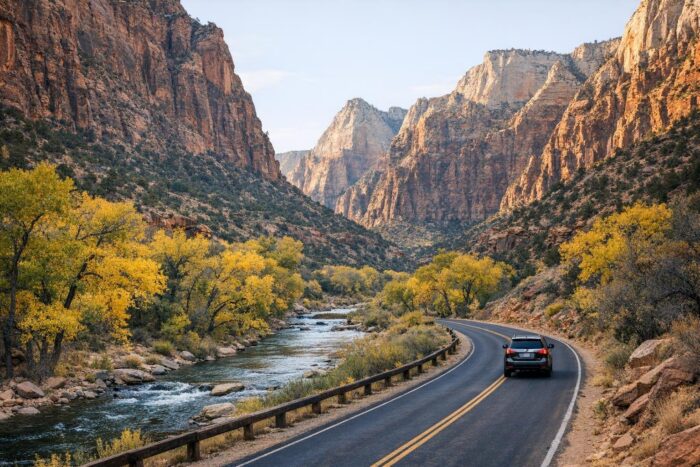
The best national parks in the USA are not only the famous ones. They are the parks where the drive in is part of the show: a road that climbs above the tree line, follows a rim, threads through giant trees or runs along a wild coast. This guide picks those parks, region by region, and gives you for each one the scenic road to take, the season that works and the number of days to plan.
The United States now has 64 national parks, since Chiricahua in Arizona was redesignated from national monument to national park in October 2026. You cannot see them all in one trip, and you do not need to. Most travelers build a road trip around one region and two to four parks that sit close together. That is how this page is organized.
At the end you will find how the America the Beautiful pass works in 2026, which parks pair naturally in a single loop and answers to the questions we hear most often.
The best national parks at a glance
The table sums up the parks covered below. “Days” means time inside the park, not counting the drive to reach it.
| Park | Region | Signature drive | Best season | Days |
|---|---|---|---|---|
| Yellowstone | Rockies | Grand Loop Road | Late May to September | 3 to 4 |
| Grand Teton | Rockies | Teton Park Road | June to September | 1 to 2 |
| Glacier | Rockies | Going-to-the-Sun Road | July to September | 2 to 3 |
| Rocky Mountain | Rockies | Trail Ridge Road | June to September | 2 |
| Yosemite | California | Tioga Road, Glacier Point Road | May to October | 2 to 3 |
| Sequoia and Kings Canyon | California | Generals Highway | May to October | 2 |
| Joshua Tree | California | Park Boulevard | October to April | 1 to 2 |
| Death Valley | California | Badwater Road | November to March | 1 to 2 |
| Redwood | California | Newton B. Drury Scenic Parkway | Year-round | 1 to 2 |
| Olympic | Northwest | US-101 loop | July to September | 3 |
| Mount Rainier | Northwest | Paradise and Sunrise roads | July to September | 1 to 2 |
| Crater Lake | Northwest | Rim Drive | July to September | 1 |
| Grand Canyon | Southwest | Desert View Drive | March to May, September to November | 2 |
| Big Bend | Southwest | Ross Maxwell Scenic Drive | November to April | 2 to 3 |
| White Sands | Southwest | Dunes Drive | October to April | Half a day |
| Great Smoky Mountains | East | Newfound Gap Road | April to June, October | 2 to 3 |
| Shenandoah | East | Skyline Drive | May to October | 1 to 2 |
| Acadia | East | Park Loop Road | June to mid-October | 2 to 3 |
| Everglades | East | Main Park Road | December to April | 1 to 2 |
Rocky Mountain region: the classic national park road trip
If you only make one big national park trip, the northern Rockies are hard to beat. The parks are huge, the roads are spectacular and several of them sit within a day’s drive of each other.
Yellowstone
The world’s first national park is built around the Grand Loop Road, a figure-eight of about 142 miles that links Old Faithful, Grand Prismatic Spring, the Grand Canyon of the Yellowstone, Lamar Valley and Yellowstone Lake. Five entrances feed into it from Montana, Wyoming and Idaho. Most park roads close to regular vehicles from early November to spring; the road between the North and Northeast entrances is the exception and stays open all year. Plan three days at minimum, four if you want dawn wildlife watching in Lamar or Hayden Valley.
Grand Teton
Grand Teton lies just south of Yellowstone, linked to it by the John D. Rockefeller, Jr. Memorial Parkway, so the two pair naturally. Teton Park Road runs along the base of the range past Jenny Lake, while the highway on the eastern side gives the wide views of Oxbow Bend and Snake River Overlook. One full day covers the highlights; two lets you hike or paddle.
Glacier
Going-to-the-Sun Road crosses Glacier for about 50 miles and tops out at Logan Pass on the Continental Divide. It is one of the most dramatic mountain roads in North America, and also one of the most seasonal: there is no set opening date over Logan Pass, and the park says the road has typically been fully open by early July. Glacier did not use a park-wide vehicle reservation in 2026, managing traffic on the busiest corridors instead. Give it two to three days and expect alpine weather even in August.
Rocky Mountain
Trail Ridge Road covers 48 miles between Estes Park and Grand Lake and peaks at 12,183 feet, crossing miles of open tundra where elk graze above the tree line. The road usually closes for winter, so the window runs from late spring to mid-fall. Rocky Mountain is the big Rockies park that still ran a timed entry system in 2026, from May 22 into October, with a separate permit for the Bear Lake Road corridor. Two days from Denver works well.
California’s best national parks: granite, giants and desert
California has nine national parks, more than any other state, and they cover every landscape from coastal forest to the lowest point in North America.
Yosemite
Yosemite Valley is open all year, but two of the park’s best drives are seasonal: Tioga Road crosses the high country over Tioga Pass in summer and fall, and Glacier Point Road leads to the view over Half Dome. Waterfalls peak with the snowmelt in late spring. Yosemite dropped its entrance reservation system for 2026, relying on traffic monitoring instead, but summer weekends remain crowded. Plan two to three days.
Sequoia and Kings Canyon
These two adjoining parks are managed together and linked by the Generals Highway. Sequoia holds the General Sherman Tree, the largest tree on Earth by volume. Kings Canyon adds Grant Grove and, in the warmer months, the Kings Canyon Scenic Byway down into one of the deepest canyons in the country. Chains can be required on the mountain roads in winter. Two days covers both.
Joshua Tree and Death Valley
The desert parks flip the usual calendar. Joshua Tree, with its boulder piles and twisted trees along Park Boulevard, is at its best from fall to spring. Death Valley, home of Badwater Basin at 282 feet below sea level, is a winter destination: summer heat there is dangerous, and fuel stops are far apart. One or two days each is enough for most road trippers.
Redwood
Redwood protects the tallest trees on Earth along US-101 in far northern California. The Newton B. Drury Scenic Parkway is the drive to take, a quiet road through old-growth groves that bypasses the highway. It works year-round and sits on the coastal route between San Francisco and Oregon.
Pacific Northwest: rainforest, volcanoes and the deepest lake
Olympic
Olympic is three parks in one: glaciated peaks, the moss-draped Hoh Rain Forest and a wild Pacific coast with sea stacks at Ruby Beach. No road crosses the interior, so you drive around it on US-101 and take spur roads in. Three days is the realistic minimum for the full loop.
Mount Rainier
At 14,410 feet, Rainier dominates the skyline less than three hours from Seattle. The Paradise area has the wildflower meadows and the main trailheads; Sunrise, reached by a road open only in summer, is the highest point in the park you can drive to. Mount Rainier did not require timed entry in 2026. Late July to early September is the snow-free window for most trails.
Crater Lake
Crater Lake in Oregon is the deepest lake in the United States, a caldera filled with startlingly blue water. Rim Drive circles it for about 33 miles, but heavy snow keeps most of it closed until summer. A single day from the coast or from I-5 is enough to drive the rim and stop at the overlooks.
The Southwest beyond Utah
Utah’s five parks deserve a trip of their own, and we cover the Mighty 5 in a separate guide. Outside Utah, the Southwest still offers some of the most varied park driving in the country.
Grand Canyon
The South Rim is open year-round and has two scenic roads: Desert View Drive heads east to the Watchtower, and Hermit Road heads west, served by park shuttles for most of the year because private cars are restricted. Spring and fall are the comfortable seasons. Two days lets you catch both sunrise and sunset from the rim.
Big Bend, White Sands and Carlsbad Caverns
West Texas and southern New Mexico make a remote but rewarding loop. Big Bend’s Ross Maxwell Scenic Drive runs past desert peaks to Santa Elena Canyon on the Rio Grande; distances are long, so fill the tank before you arrive and visit between November and April. White Sands, with its brilliant gypsum dunes along Dunes Drive, can close for a few hours during tests on the neighboring missile range. Carlsbad Caverns adds the Big Room underground and, on summer evenings, the bat flight at the natural entrance.
Eastern national parks: forests, coast and fall color
Great Smoky Mountains
The Smokies were the most visited national park in 2025, with about 11.5 million recreation visits according to the National Park Service. There is no entrance fee, but a parking tag is required to park for more than 15 minutes. Newfound Gap Road crosses the park between Gatlinburg, Tennessee, and Cherokee, North Carolina, and the Cades Cove loop is the place for wildlife and historic cabins. Fall color usually peaks in the second half of October.
Shenandoah
Skyline Drive runs 105 miles along the crest of the Blue Ridge Mountains in Virginia, the only public road through the park, with dozens of overlooks. At its southern end it connects to the Blue Ridge Parkway, which continues all the way to the Great Smoky Mountains. One or two days covers the drive.
Acadia
Acadia on Maine’s Mount Desert Island combines granite coast and mountain views on the Park Loop Road, open from April 15 to December 1. The road to the summit of Cadillac Mountain required a vehicle reservation from May 20 to October 25 in 2026. Early October brings the fall color and the last of the comfortable weather.
Everglades
The Everglades are flat, which surprises first-time visitors, but the wildlife is the draw: alligators, wading birds and, near Flamingo, the chance of crocodiles and manatees. The Main Park Road runs 38 miles from the Homestead entrance to Flamingo. Visit in the dry season, roughly December to April, when animals gather near water and mosquitoes are bearable.
The America the Beautiful pass and park fees in 2026
Most headline parks charge a seven-day entrance fee per vehicle; Acadia and the Everglades, for example, charge $35 per private vehicle. If your road trip includes three or more fee-charging parks, the annual America the Beautiful pass usually pays for itself.
- Resident annual pass: $80 for U.S. citizens and residents.
- Non-resident annual pass: $250, introduced in 2026.
- Senior passes: $20 a year or $80 for life, for U.S. citizens and residents aged 62 and over.
- Free passes: current military and their dependents, veterans and Gold Star families, U.S. residents with a permanent disability, and U.S. fourth graders.
The pass covers the entrance fee for one private vehicle and its passengers. It does not cover timed entry or reservation fees, such as the $6 Cadillac Mountain reservation. Since 2026, non-residents aged 16 and over pay an extra $100 per person at 11 of the busiest parks (Acadia, Bryce Canyon, Everglades, Glacier, Grand Canyon, Grand Teton, Rocky Mountain, Sequoia and Kings Canyon, Yellowstone, Yosemite and Zion) unless they hold an annual or America the Beautiful pass. Fee-free days in 2026 are now reserved for U.S. citizens and residents; the last two of the year are October 27 and November 11.
Parks to combine in one road trip
The best national park road trips link parks that are close together, so you spend your days on scenic roads rather than interstates. These pairings work well:
- Yellowstone and Grand Teton: directly connected, five to six days for both, easy to extend north to Glacier.
- Yosemite, Sequoia and Kings Canyon: the Sierra Nevada trio, about a week from San Francisco or Los Angeles.
- Joshua Tree and Death Valley: a winter desert loop from Los Angeles or Las Vegas.
- Olympic, Mount Rainier and Crater Lake: a summer Northwest loop, with Redwood if you continue south on US-101.
- Grand Canyon and Petrified Forest: linked by I-40 and old Route 66 in northern Arizona.
- Big Bend, Guadalupe Mountains, Carlsbad Caverns and White Sands: a late fall or winter loop through the Chihuahuan Desert.
- Shenandoah and Great Smoky Mountains: Skyline Drive plus the Blue Ridge Parkway, best in October.
Whatever region you pick, check each park’s conditions page before you leave. Seasonal road openings, reservation rules and fees change from year to year, and several of the systems described here were adjusted for 2026.
FAQ about the best national parks
How many national parks are there in the US?
There are 64 national parks. Chiricahua in Arizona became the newest in October 2026. California has the most with nine, followed by Alaska with eight and Utah with five.
Which national park is the most visited?
Great Smoky Mountains, with about 11.5 million recreation visits in 2025, far ahead of Zion and Yellowstone, according to National Park Service figures.
Do I need a reservation to enter national parks in 2026?
Only a few parks use them. Rocky Mountain ran timed entry in 2026, and Acadia required a reservation for Cadillac Summit Road. Yosemite, Glacier, Mount Rainier and Arches did not use timed entry in 2026.
What is the best region for a first national park road trip?
Yellowstone and Grand Teton in summer offer the most variety in the shortest distance: geysers, wildlife, lakes and mountain views within a few hours’ drive.