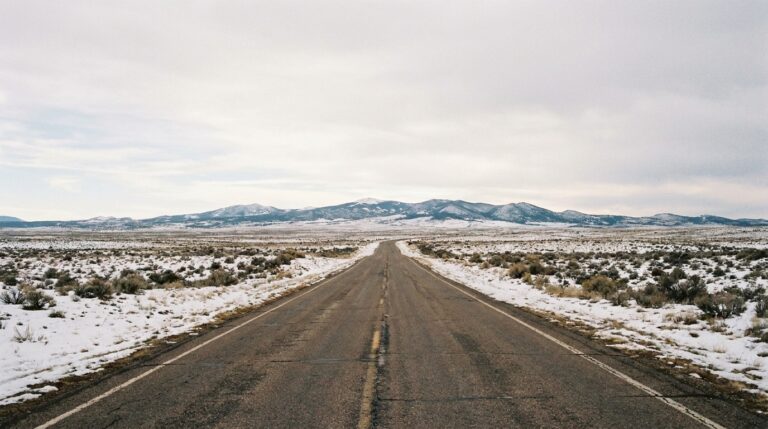
Route 66 crosses the Texas Panhandle for about 178 miles, from the Oklahoma line west of Texola to the ghost town of Glenrio on the New Mexico border. Much of the old road runs as a frontage road beside I-40, so it is easy to hop on and off, and the flat, wide-open plains make the roadside landmarks stand out from miles away.
This guide follows the road from east to west, the direction most people drive it: Shamrock, McLean, Groom, Amarillo, Vega, Adrian and Glenrio, with a detour to Palo Duro Canyon.
Route 66 Texas at a glance
| Stop | Why go |
|---|---|
| Shamrock | U-Drop Inn and Tower Station, a 1936 Art Deco landmark |
| McLean | Devil’s Rope Museum and a restored 1929 Phillips 66 station |
| Groom | Leaning water tower and a 190-foot cross |
| Amarillo | Sixth Avenue historic district, Cadillac Ranch, Big Texan Steak Ranch |
| Vega | Restored Magnolia service station |
| Adrian | The self-declared midpoint of Route 66 |
| Glenrio | Ghost town on the New Mexico line |
Shamrock and the U-Drop Inn
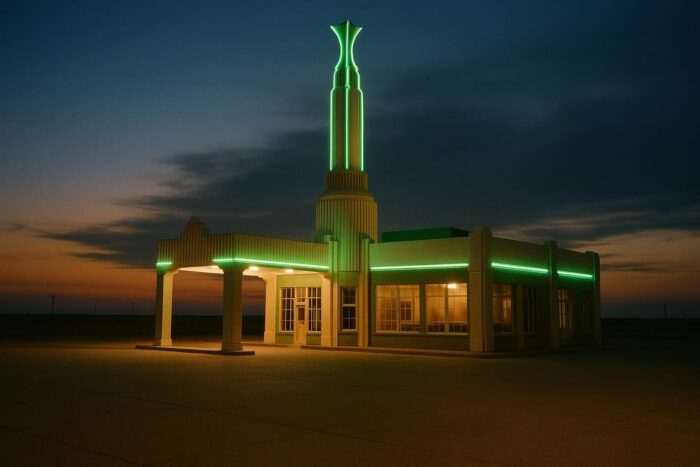
The first town in Texas is Shamrock, and its main attraction is the reason many people stop at all. The Tower Station and U-Drop Inn, built in 1936, is one of the finest Art Deco buildings on the entire highway, with a tall, tapering tower that rises above the old service station and café. It was restored in the early 2000s, is listed on the National Register of Historic Places, and now houses a visitor center and museum. Its design inspired Ramone’s body shop in the movie Cars.
In 2025, a café reopened inside the U-Drop Inn for the first time in more than 25 years, so you can again eat inside the building. Come back after dark if you can: the neon on the tower is the classic photo.
McLean: barbed wire and an early Phillips 66 station
McLean was the last Texas Route 66 town to be bypassed by I-40, in 1984, and its small downtown still feels like a stop on the old road. The Devil’s Rope Museum is devoted to barbed wire, the invention that fenced the open range, and shares its building with a Texas Route 66 exhibit. It is seasonal, generally open from spring to fall, so check before you plan around it.
A few blocks away, a tiny cottage-style Phillips 66 station, with a steep gabled roof and a chimney, opened in 1929 and was restored in the 1990s. Its plaque calls it the first Phillips station in Texas, a claim some historians dispute, but it is certainly one of the earliest and one of the most charming.
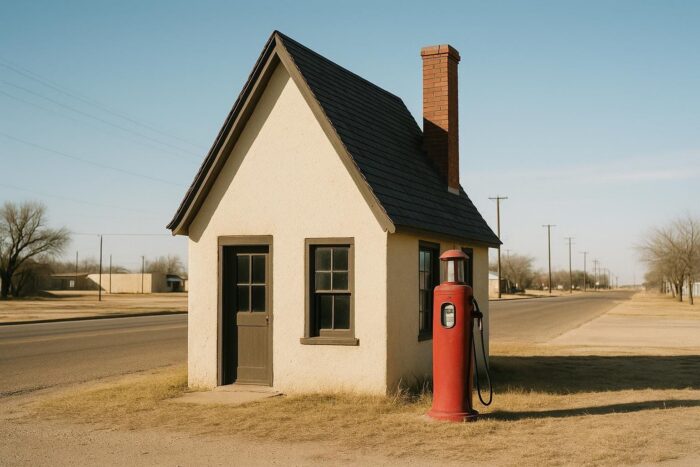
Groom: the leaning tower and the cross
Past the small community of Alanreed, Groom offers two very different landmarks visible from the interstate. The leaning water tower is a condemned tank that a local businessman set up at a deliberate tilt to draw drivers to his truck stop, and it still works as a photo stop.
West of town, near I-40 exit 112, a cross about 190 feet tall rises over the plains. It was put up in 1995, and the Stations of the Cross are set around its base.
Route 66 in Amarillo
Amarillo is the largest city on the Texas stretch and the natural overnight stop. Route 66 followed Sixth Avenue through the San Jacinto neighborhood, and 13 blocks of it are listed on the National Register as a historic district. Today the street is lined with antique shops, galleries, bars and restaurants, including the Golden Light Café, serving burgers since 1946, with live music in the cantina next door on many nights.
West of town, Cadillac Ranch is the most famous roadside art on Route 66: ten Cadillacs from 1949 to 1963, buried nose-first in a field by the art group Ant Farm in 1974, with funding from local businessman Stanley Marsh 3. The installation was moved about two miles west in 1997 to stay ahead of the growing city. It sits on private land reached through an open gate, and visitors are encouraged to add their own spray paint. For more stops of this kind, see our Route 66 attractions guide.
The Big Texan Steak Ranch is known for its 72-ounce steak challenge: finish the full meal, with the steak, shrimp cocktail, baked potato, salad and roll, in one hour. Next to its RV park, you will also find the Slug Bug Ranch, a row of half-buried Volkswagen Beetles that moved to Amarillo from nearby Conway in 2024. If an older guide sends you to Conway for it, head to Amarillo instead.
Palo Duro Canyon: the detour worth taking
About 25 to 30 miles south of Amarillo, via the town of Canyon, Palo Duro Canyon State Park protects what Texas Parks and Wildlife calls the second largest canyon in the country. A half day is enough for a scenic drive to the canyon floor and a short hike. The park often reaches capacity on busy days, so reserve in advance even for day use, and note that trails close in wet weather or extreme heat.
Vega, Adrian and Glenrio
Vega has a restored 1924 Magnolia service station, reopened as a visitor stop in 2004, and the Milburn-Price Culture Museum, a hands-on museum of local and Route 66 history.
Adrian is famous for a sign across from the MidPoint Cafe claiming the town is 1,139 miles from both Chicago and Los Angeles. Treat it as a friendly claim rather than a surveyed fact; it is still the obvious place for a photo and a slice of the café’s “ugly crust” pie. The café is seasonal, roughly spring to fall, and can close without notice, so call ahead outside summer. Our guide to classic Route 66 eateries lists other diners along the way.
The last stop in Texas is Glenrio, a former railroad town that straddles the New Mexico line. I-40 bypassed it in the 1970s, and its last business closed in 1976. Today it is a historic district on the National Register, with abandoned buildings and a stretch of old roadbed. Look, but respect private property and do not enter the buildings.
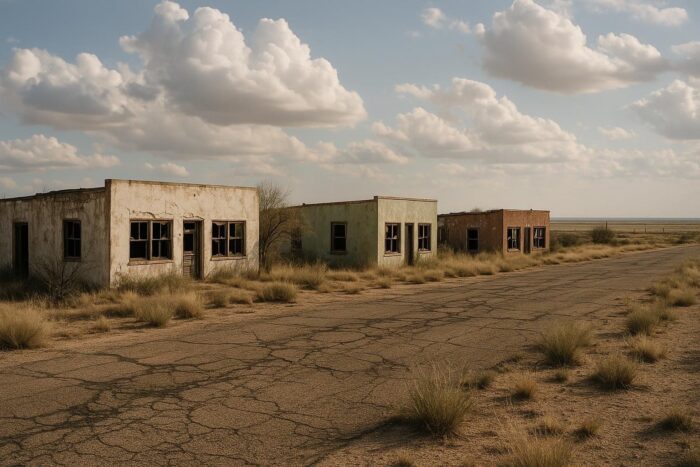
How many days for Route 66 in Texas?
One full day covers the Texas stretch with stops, with a night in Amarillo. Add a second day for Palo Duro Canyon and a slower look at Sixth Avenue. For the pacing of the whole drive, from Chicago to Santa Monica, see our complete Route 66 itinerary.
Spring and fall are the most comfortable seasons. Severe weather, including hail and tornadoes, peaks from April to June on the plains, and winter storms can make the drive difficult, so check road conditions from November to March. Amarillo hosts the Texas Route 66 Festival each June, and the 2026 centennial edition spread events across several Panhandle towns.
Route 66 Texas FAQ
How many miles of Route 66 are in Texas?
About 178 miles across the Panhandle, according to the Texas Historical Commission. Other sources give slightly different figures depending on the alignment.
What is the best stop on Route 66 in Texas?
Cadillac Ranch in Amarillo is the most famous, but the U-Drop Inn in Shamrock is the finest building on the Texas stretch.
Can you spray paint Cadillac Ranch?
Yes. Visitors are encouraged to add their own paint. Take your empty cans with you.
Where is the midpoint of Route 66?
In Adrian, Texas, where a sign across from the MidPoint Cafe says 1,139 miles to both Chicago and Los Angeles.