A good road trip packing list is less about bringing more and more about not forgetting the few things that are hard to replace on the road: documents, a working spare tire, a charger, water and a basic emergency kit. Everything else can usually be bought at the next town.
This checklist is organized by category, with the items recommended by agencies such as the National Highway Traffic Safety Administration (NHTSA), Ready.gov and the CDC where they apply. Adapt it to your route, your season and who is traveling with you.
Road trip packing checklist at a glance
| Category | Essentials |
|---|---|
| Documents | Driver’s license, registration, proof of insurance, rental agreement, park pass |
| Car and safety | Spare tire, jack, tire gauge, jumper cables, flashlight, reflective triangle |
| Navigation and tech | Offline maps, paper atlas, car charger, power bank |
| Food and water | Water, nonperishable snacks, cooler with a thermometer |
| Health | First-aid kit, medications, sunscreen, hand sanitizer |
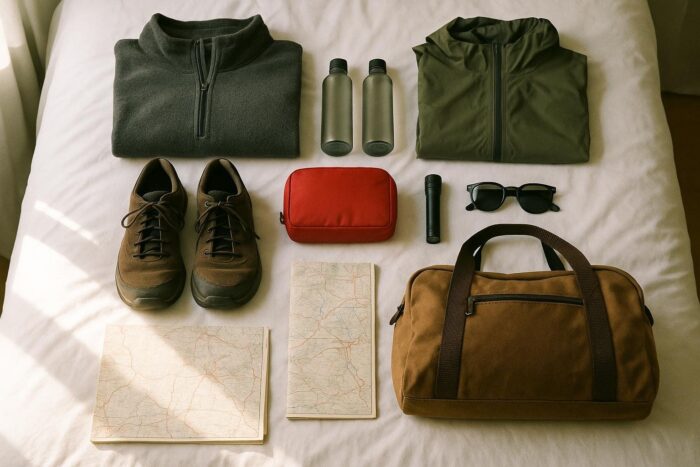
| Clothing | Layers, rain jacket, walking shoes, hat |
Documents and money
- Driver’s license for every person who will drive.
- Vehicle registration and proof of insurance, kept in the glove box, or the rental agreement and the rental company’s roadside assistance number.
- ID for flights if you fly to your starting point. Since May 7, 2025, TSA checkpoints require a REAL ID-compliant license or another accepted ID, such as a passport.
- International drivers: whether you need an International Driving Permit depends on the state. The United States does not issue permits to visitors, so get one in your home country before you leave.
- A national park pass if your route crosses several parks.
- A credit card and some cash for small towns, tolls and farm stands that do not take cards.
Take a photo of each document and store it offline on your phone, in case the originals are lost.
Car and safety kit
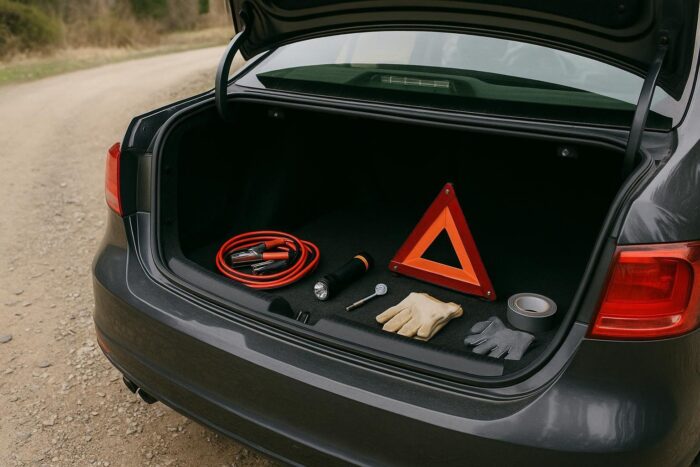
Ready.gov and NHTSA both recommend keeping an emergency kit in the car. A practical version for a road trip includes:
- Jumper cables
- Flashlight with spare batteries
- Reflective triangle or flares
- Tire pressure gauge, jack and a check that the spare is inflated
- Work gloves, basic tools and duct tape
- Emergency blankets
- Extra windshield washer fluid
- In winter: an ice scraper, warm blankets and sand or cat litter for traction
Check tire pressure before you leave. NHTSA advises checking all tires, including the spare, at least once a month and before long trips, when the tires are cold, meaning the car has not been driven for about three hours. The recommended pressure is on the label inside the driver’s door frame, not the number molded on the tire.
Navigation and tech
- Offline maps for the whole route, downloaded before you leave. Many scenic routes and national parks have no cell coverage.
- A paper road atlas or state maps as a backup.
- A car charger and cables for every device, plus a power bank for hikes and motel rooms with few outlets.
- A phone mount so the driver never holds the phone.
- Downloaded music, podcasts and audiobooks for areas without signal.
Food, water and the cooler
Carry more water than you think you need, especially in the desert Southwest, where the National Park Service recommends at least a gallon per person per day, and more if you hike. A reusable jug and refillable bottles save money and stops.
If you pack perishable food, the USDA recommends keeping it at 40°F or below in the cooler and using a thermometer to check. Do not leave perishables out for more than two hours, or one hour when it is above 90°F. A full cooler stays cold longer, and a separate cooler for drinks keeps the food cooler closed more often. For what to put in it, our list of easy road trip snacks covers ideas for kids and adults.
Health and first aid
- A first-aid kit with adhesive bandages, gauze, tape, antiseptic wipes, antibiotic ointment, tweezers, a cold compress, a thermometer and pain relievers. The American Red Cross publishes a full list for a family kit.
- Prescription medications for the whole trip plus a few extra days, in their original containers.
- Sunscreen with SPF 15 or higher and broad-spectrum protection, reapplied at least every two hours and after swimming or sweating, as the CDC recommends.
- Insect repellent, hand sanitizer and wet wipes.
- Motion sickness remedies if anyone in the car needs them.
Clothing and personal items
Pack for the full range of weather on your route, not just the destination. A drive that starts in a hot valley can climb to cold mountain passes the same day. The basics:
- Layers: T-shirts, a fleece or sweater, and a light insulated jacket
- A rain jacket
- Comfortable walking or hiking shoes, plus sandals
- A hat and sunglasses
- A swimsuit and a quick-dry towel
- A small bag for one night, so you do not unload the whole trunk at every motel
Check the forecast for each leg a few days before you go; our guide to weather forecasts for road trip routes explains which tools to use.
Traveling with kids or pets
Add car seats that fit your children’s age and size, a bag of activities within reach, and a change of clothes in the car rather than the trunk. For pets, bring food, a water bowl, a leash, waste bags and vaccination records.
Never leave a child or a pet alone in a parked car. NHTSA notes that the inside of a car can heat up by almost 20°F in 10 minutes, and that cracking a window does little to help.
Before you leave
- Check tires, oil, coolant, lights and wipers, or have the car serviced if a check is due.
- Book the first night and any nights in popular areas.
- Share your route and schedule with someone at home.
- Clean out the car so there is room for what you buy on the way.
For the full planning process, from route to budget, see how to plan a road trip in the USA.
Road trip packing checklist FAQ
What should you always keep in the car on a road trip?
Documents, a spare tire and jack, jumper cables, a flashlight, a first-aid kit, water, snacks and a phone charger.
How much water should you bring on a road trip?
At least a gallon per person per day in hot or desert areas, and more if you plan to hike.
Do you need a REAL ID for a road trip?
Not for driving. A valid driver’s license is enough. You need a REAL ID or another accepted ID only if you fly within the US.
How do you pack a car for a long road trip?
Put heavy bags low in the trunk, keep the emergency kit and an overnight bag easy to reach, and never block the driver’s view.