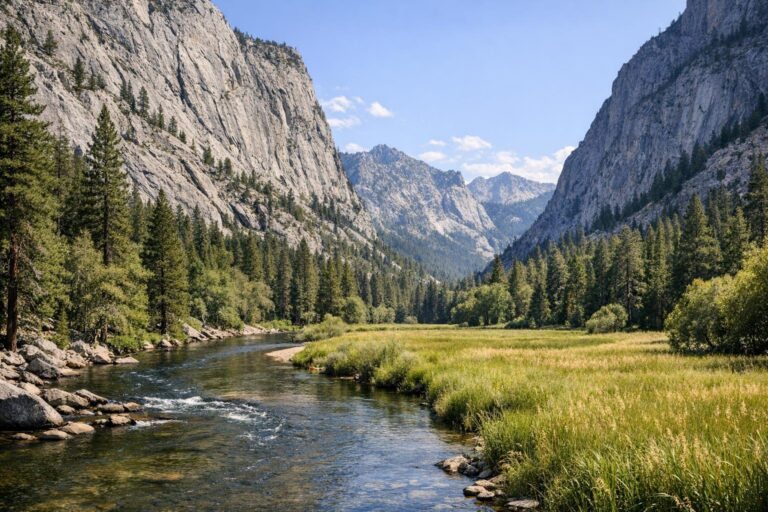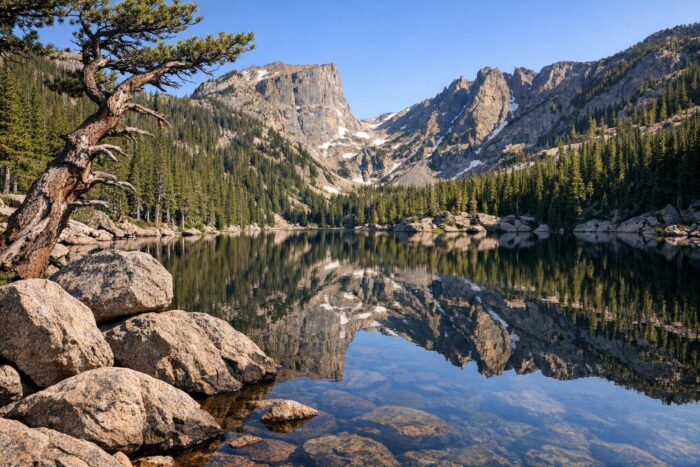
There are four national parks in Colorado: Rocky Mountain, Great Sand Dunes, Mesa Verde and Black Canyon of the Gunnison. They could hardly be more different. One is high alpine tundra, one is a field of giant dunes, one is an archaeological preserve and one is a canyon so deep and narrow that sunlight barely reaches the river.
All four can be reached by car on paved roads, and they line up in a loop that starts and ends in Denver. Here is what each park offers and how to string them together.
The four Colorado national parks at a glance
| Park | Region | National park since | Vehicle fee | Best season |
|---|---|---|---|---|
| Rocky Mountain | Northern Front Range, near Estes Park | 1915 | $30 (1 day) or $35 (7 days) | June to early October |
| Great Sand Dunes | San Luis Valley, near Alamosa | 2004 | $25 | Late spring and fall |
| Mesa Verde | Southwest, near Cortez | 1906 | $30 in summer (7 days), $20 in winter | May to October, for the tours |
| Black Canyon of the Gunnison | West, near Montrose | 1999 | $30 (7 days) | May to October |
Fees are per private vehicle as listed by the National Park Service. With four parks on one trip, the $80 America the Beautiful annual pass costs less than paying at each gate.
Rocky Mountain National Park
The most visited of the four, with more than 4.1 million recreation visits in 2025. Its highlight is Trail Ridge Road, the 48-mile crossing between Estes Park and Grand Lake that tops out at 12,183 feet. The road is usually closed from mid-October to late May, and in summer the park requires a timed entry reservation during the day. Plan two days at least: one for the drive, one for the lakes around Bear Lake.
Great Sand Dunes National Park and Preserve
The tallest dunes in North America, rising about 750 feet against the Sangre de Cristo Mountains. You park, cross the Medano Creek bed and climb wherever you like. In spring, snowmelt can spread a shallow creek across the sand, though dry years such as 2026 skip it. In summer, the sand surface can reach about 150°F by afternoon, so climb at sunrise or in the evening. One night nearby is enough for most travelers, and the park is a certified dark sky site.
Mesa Verde National Park
Ancestral Puebloan villages built into cliff alcoves, including Cliff Palace, the largest in the park. Entering the major dwellings requires a ranger-led tour, booked on Recreation.gov 14 days ahead; in 2026 the tour season ran from May 4 to October 21. The drive from the entrance to the tour sites takes up to an hour and a half, so give the park a full day.
Black Canyon of the Gunnison National Park
The least known of the four, and for many visitors the biggest surprise. The Gunnison River has cut a sheer, dark gorge whose Painted Wall stands about 2,250 feet tall, the tallest sheer cliff in Colorado. The South Rim, about 14 miles northeast of Montrose, has a paved road with 12 overlooks you can reach by car, including Chasm View and Pulpit Rock. Steep East Portal Road drops to the river, but it has a 16 percent grade and bans vehicles over 22 feet.
The North Rim is wilder, with a road whose last 7 miles are unpaved. There is no bridge across the canyon, so switching rims takes 2 to 3 hours by car. In winter, the South Rim drive closes to vehicles just past the visitor center and the North Rim closes to cars entirely.
A road trip loop through Colorado’s national parks
The four parks form a natural circle around the state’s mountains. A comfortable version takes eight to ten days:
- Denver to Rocky Mountain (2 nights): about 66 miles to Estes Park via US-36. Drive Trail Ridge Road one day, hike around Bear Lake the next.
- Rocky Mountain to Great Sand Dunes (1 to 2 nights): head south past Denver on I-25, then west on US-160 over La Veta Pass and north on Highway 150 to the dunes.
- Great Sand Dunes to Mesa Verde (2 nights): follow US-160 west across the San Juan Mountains over Wolf Creek Pass, through Pagosa Springs and Durango, to Cortez.
- Mesa Verde to Black Canyon (1 to 2 nights): drive north from Durango on US-550 through Silverton and Ouray to Montrose, one of the most dramatic mountain roads in the state.
- Black Canyon back to Denver: take US-50 east through Gunnison, or go north to I-70 for the faster interstate return.
Mountain passes on this loop can see snow from October to May, and timed entry, tour tickets and the opening of Trail Ridge Road all point to the same window: June through September is the easiest time to drive the full circle. Late September adds golden aspens along the way.
If you are weighing Colorado against other regions, our region-by-region picks of the parks most worth a road trip compares them by season and driving time.
Colorado national parks FAQ
How many national parks are in Colorado?
Four: Rocky Mountain, Great Sand Dunes, Mesa Verde and Black Canyon of the Gunnison. The state also has several national monuments, which are separate designations.
Can you see all four Colorado national parks in one trip?
Yes. A loop from Denver covers all four in eight to ten days without rushing.
Which Colorado national park is best for a first visit?
Rocky Mountain is the easiest from Denver and offers the most variety. Add Great Sand Dunes for a contrast if you have one more day.
Do I need reservations for Colorado’s national parks?
In season, Rocky Mountain requires timed entry and Mesa Verde requires tickets for its cliff dwelling tours. Great Sand Dunes and Black Canyon only require the entrance fee.