Rocky Mountain National Park sits about 66 miles northwest of Denver, close enough for a day trip and big enough to fill a week. The park straddles the Continental Divide, and its signature drive, Trail Ridge Road, climbs from mountain meadows to open alpine tundra in well under an hour.
The catch is timing. Trail Ridge Road only opens for part of the year, and in summer and early fall you need a timed entry reservation on top of your entrance pass. Here is how the park works for a road trip: the routes, the permit rules for 2026, the wildlife, and how long to stay.
Where Rocky Mountain National Park is and how to get there from Denver
The park has two gateway towns. Estes Park sits on the east side and handles most of the traffic. Grand Lake, on the west side, is quieter and opens onto the Kawuneeche Valley, where the Colorado River begins.
The National Park Service lists three main routes from Denver to Estes Park:
- US-36 through Boulder: 66 miles, about 1.5 to 2 hours. The fastest option for most drivers.
- CO-66 via Lyons: 71 miles, also 1.5 to 2 hours, handy if you are coming from the northern suburbs.
- Peak to Peak Scenic Byway: 108 miles, about 2.5 to 3 hours, through Nederland along the foothills. Slow, but a good way to arrive.
To reach Grand Lake, leave I-70 at Empire and take US-40 over Berthoud Pass to Granby, then US-34 north. That is about 61 miles from the interstate. US-40 can see winter closures or chain restrictions, so check conditions before a cold-season drive. There is no public transit from Denver International Airport to the park, so a rental car is the practical choice for most visitors.
Trail Ridge Road: the drive across the Divide
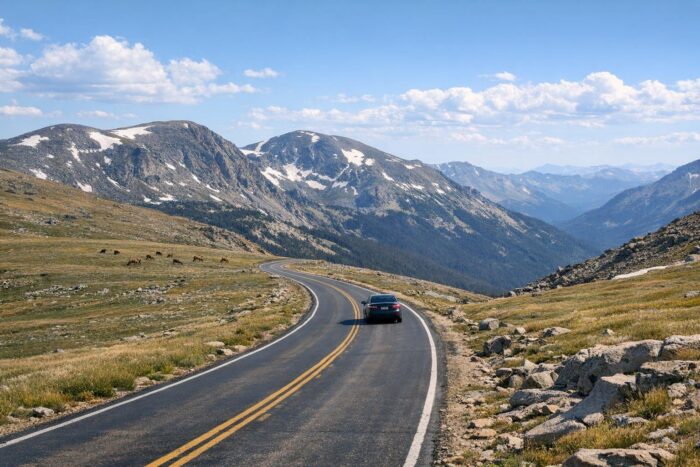
Trail Ridge Road (US-34) runs 48 miles between Estes Park and Grand Lake. It tops out at 12,183 feet, and about 11 miles of it run above treeline at roughly 11,500 feet. You gain around 4,000 feet in a short stretch from either town, which is why the air feels thin and the summit pullouts are often cold and windy, even in July.
The road is part of the national All-American Road program, and it crosses the Continental Divide at Milner Pass, 10,758 feet. The park recommends at least half a day for the crossing, and that is for a drive with a few stops. Plan more if you want to walk.
Good stops along the way:
- Many Parks Curve and Rainbow Curve: wide views back over the eastern valleys.
- Tundra World Nature Trail at Rock Cut: a half-hour walk on the alpine tundra. Stay on the path; tundra plants take decades to recover.
- Milner Pass: the Continental Divide sign and Poudre Lake.
- Kawuneeche Valley: the wide meadows on the west side, often good for wildlife at dawn and dusk.
Weather moves fast up high. Afternoon thunderstorms are common in July and August, and lightning on exposed tundra is a real hazard. Drive the high section in the morning when you can.
Seasonal opening: when Trail Ridge Road is open
According to the park, Trail Ridge Road is closed from approximately mid-October through late May. Exact dates depend on snow, so they change every year. Even in summer, a storm can close the high section for a few hours. The park runs a recorded road status line at (970) 586-1222.
Out of season, the lower parts of the park stay open on both sides. You can still drive to Bear Lake, Moraine Park and the Kawuneeche Valley, but you cannot cross from Estes Park to Grand Lake inside the park. If you are planning a fall trip, late September and early October give you aspen color, the elk rut, and in most years an open Trail Ridge Road.
Bear Lake Road and the hiking hub
Bear Lake Road runs from the Beaver Meadows area up to Bear Lake, one of the busiest trailheads in the park. From there, short walks reach Nymph, Dream and Emerald Lakes, a classic morning hike that climbs gently past three alpine lakes under Hallett Peak.
Parking at Bear Lake fills early in summer. The park runs a seasonal shuttle along the corridor, and using it is often easier than circling the lot. Either way, you need the right reservation to drive into the corridor during peak hours, which brings us to permits.
Timed entry reservations for 2026
Rocky Mountain National Park runs a timed entry permit system in its busy season. For 2026, the park set it up this way:
| Permit | Hours | 2026 dates | What it covers |
|---|---|---|---|
| Timed Entry | 9 a.m. to 2 p.m. | May 22 to October 12 | Whole park except the Bear Lake Road Corridor |
| Timed Entry+ Bear Lake Road | 5 a.m. to 6 p.m. | May 22 to October 18 | Whole park including the Bear Lake Road Corridor |
A few rules worth knowing:
- Reservations are sold only through Recreation.gov (website, app or phone), never at the entrance stations. Each one carries a $2 non-refundable processing fee.
- You still need a park entrance pass. The reservation only gives you a two-hour window to enter; once inside, you can stay as long as you like.
- Blocks of dates open on the first of the month before, at 8 a.m. Mountain time. A second batch is released at 7 p.m. the night before each arrival date.
- One reservation per vehicle per day, and the person who booked must be in the car.
- Arriving before the permit hours (before 9 a.m., or before 5 a.m. for Bear Lake Road) lets you in without a reservation.
The park has not yet published its 2027 system, so check Recreation.gov in early spring.
Entrance fees and passes
A private vehicle pays $30 for one day or $35 for seven consecutive days. A park-only annual pass costs $70. If you are visiting several parks on the same trip, the $80 America the Beautiful annual pass usually wins. Visitors who are not US residents and are 16 or older now pay an additional $100 per person at Rocky Mountain, unless they enter with an annual pass.
Wildlife: elk, bighorn sheep and moose
Elk are the stars. You can see them year-round in meadows like Moraine Park, Horseshoe Park and Upper Beaver Meadows, and in autumn the bulls bugle and gather herds during the rut. To protect them, the park closes those meadows (and Harbison and Holzwarth Meadows on the west side) to off-trail foot travel from 5 p.m. to 10 a.m. daily during the rut.
Bighorn sheep and moose live in the park too, and dawn and dusk are the best times to look for any of them. Keep at least 75 feet from elk and sheep, about two bus lengths. Never use calls or lights to attract animals; both are illegal in the park.
How many days to spend in Rocky Mountain National Park
- One day from Denver: leave early, drive Trail Ridge Road to the Alpine Visitor Center and back, with one short walk. Doable, but long.
- Two days: one day for Trail Ridge Road, one for Bear Lake and a lake hike. This is the sweet spot for most road trips.
- Three to four days: add the Kawuneeche Valley and Grand Lake, a longer hike such as Sky Pond or a visit to Wild Basin in the southeast corner.
If you have more time in Colorado, the state’s other national parks line up well for a loop south and west of Denver. For more ideas beyond the state, see our guide to the top US national parks, which sorts the big parks by region and season.
Rocky Mountain National Park FAQ
Do I need a reservation to visit Rocky Mountain National Park?
From late May to mid-October, yes, during permit hours (9 a.m. to 2 p.m. for most of the park, 5 a.m. to 6 p.m. for Bear Lake Road in 2026). Outside those dates and hours, your entrance pass is enough.
When is Trail Ridge Road open?
Usually from late May to mid-October, depending on snow. Call the road status line before you go.
Is Rocky Mountain National Park worth it in winter?
Yes, if you like snowshoeing and quiet trails. Bear Lake Road and the valleys stay open, but you cannot drive over the Divide.
How high is Trail Ridge Road?
Its highest point is 12,183 feet. Bring layers and water, and take it slowly if you are coming straight from sea level.