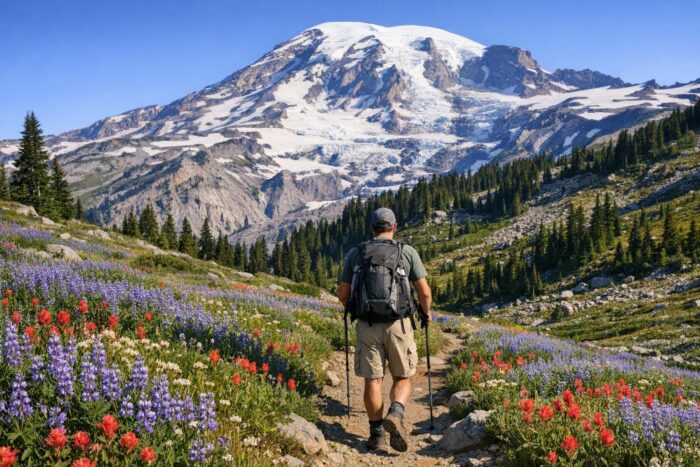
Mount Rainier National Park is built around a single volcano that rises more than 14,000 feet above Puget Sound and carries more glacial ice than any other peak in the lower 48 states. From Seattle, you can be at its flanks in under three hours, which makes it one of the most accessible big mountain parks in the country.
The trick is timing. Snow shapes everything here: which roads are open, which side of the mountain you can reach and what you need in the car. This guide covers the two main areas, Paradise and Sunrise, the access roads and the season you are aiming for.
Mount Rainier National Park in brief
Established on March 2, 1899, Mount Rainier is one of the oldest national parks in the country. It covers about 236,000 acres, and the mountain dominates every view. The park received about 1.6 million visitors in 2024, and the high roads are only free of snow for a few months each year.
| Area | Elevation | Entrance | Typical season by car |
|---|---|---|---|
| Paradise | About 5,400 ft | Nisqually (southwest) | Year-round, conditions permitting |
| Sunrise | 6,400 ft | White River (northeast) | Summer only |
| Stevens Canyon / Ohanapecosh | Lower elevations | Stevens Canyon (southeast) | Summer to late October |
| Carbon River and Mowich | Lower elevations | Northwest | Varies with conditions |
Paradise: the classic mt rainier national park visit
Paradise sits on the mountain’s south slope at about 5,400 feet, and it is where most first-time visitors go. You reach it through the Nisqually Entrance on the southwest corner of the park, then drive up past Longmire. In summer, the meadows around Paradise fill with wildflowers and a network of trails leaves from the visitor center toward glacier viewpoints.
Paradise is also famously snowy: it recorded 93.5 feet in the 1971-72 season. That is why this is the only area of the park that cars can reach in winter. Vehicle access in winter is available only from the Nisqually Entrance, and the gate at Longmire can close at any time for safety when weather and road conditions require it.
Sunrise: the high, dry side of the mountain
Sunrise, on the northeast side, is the highest point in the park you can reach by vehicle, at 6,400 feet. It faces the mountain’s glaciers head-on, and its trails cross open subalpine terrain with views toward the Cascades. Because it is on the drier east side, the weather here is often clearer when Paradise is in cloud.
The catch is the season. Sunrise Road opens only in summer: the Sunrise Visitor Center is generally open from July through mid-September, and the road closes for the season in fall. RVs and vehicles with trailers longer than 25 feet are advised not to drive past the White River Campground intersection.
Access roads and how to link them
A circuit of state highways and park roads lets you see both sides of the mountain in one trip when everything is open:
- SR 706 to the Nisqually Entrance: the main route to Longmire and Paradise.
- Stevens Canyon Road: connects Paradise to the southeast corner of the park. It has a 12 feet 6 inches tunnel height limit and usually closes in late October.
- SR 123 (Cayuse Pass) and SR 410 (Chinook Pass): link the southeast side to the White River Entrance and Sunrise. Both are expected to close for the season in mid to late November. SR 123 has a 13 feet 1 inch tunnel limit, and commercial vehicles are never allowed.
With those roads open, a full loop from Paradise through Stevens Canyon and up to Sunrise makes a long but spectacular day.
When the snow clears
For a road trip, aim for mid-July to mid-September. That is when Sunrise is open, Stevens Canyon is clear and the Paradise meadows are in bloom. June can still bring deep snow at Paradise, and fall brings early storms that close the high roads one by one.
Winter visits are possible but follow strict rules. From November 1 to May 1, every vehicle in the park must carry tire chains, including four-wheel-drive vehicles, regardless of tire type or weather.
Do you need a reservation in 2026?
No. Mount Rainier tested timed-entry reservations in 2024, at Paradise and Sunrise, and again in 2025 at Sunrise only. For 2026, the park announced on Recreation.gov that it is not using a timed-entry system for any part of the park. You still pay the regular entrance fee or use an America the Beautiful pass. Policies change from year to year, so check before your trip.
Adding Rainier to a Washington road trip
Mount Rainier pairs naturally with Olympic National Park in Washington, a few hours away on the Olympic Peninsula. Together they cover glaciers, alpine meadows, rain forest and wild coastline in a week. For more combinations across the West, see our guide to the parks that deserve a spot on your route.
Mount Rainier National Park FAQ
Paradise or Sunrise: which should I choose?
With one day and a spring or fall date, go to Paradise, the only area reachable year-round. In midsummer, both are open; Sunrise is higher and often clearer.
Can you drive to Paradise in winter?
Yes, through the Nisqually Entrance, weather permitting. Chains are required for all vehicles from November 1 to May 1, and the Longmire gate may close.
When does Sunrise Road open?
It opens only in summer, after snow removal. The visitor center is generally open from July through mid-September.
How long should I spend at Mount Rainier?
One full day covers Paradise and a short hike. Two days let you add Sunrise and the drive between them.