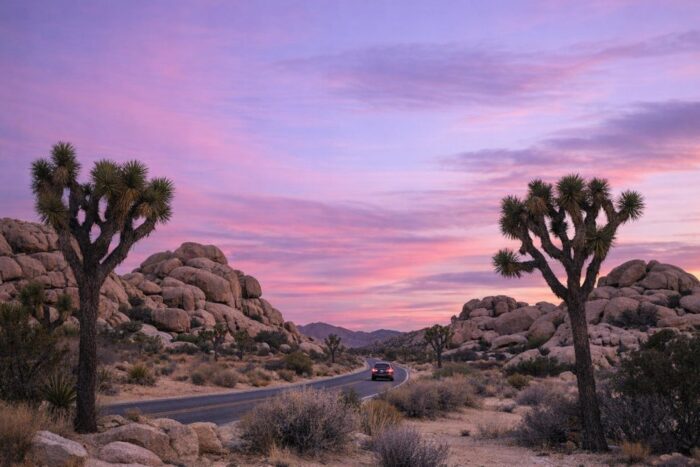
Joshua Tree National Park sits about 130 miles east of Los Angeles, where two deserts meet: the higher, cooler Mojave and the lower, hotter Colorado Desert. That split is the whole point of a visit. In a single afternoon you drive from forests of spiky Joshua trees and stacked granite boulders down into open creosote flats and a garden of cholla cactus.
The park covers 795,156 acres, but most road trippers see it along one main corridor. This guide covers the three entrances, the visitor centers, the Park Boulevard drive, the night sky, the summer heat, and how many days to give it.
Where Joshua Tree National Park is and how to get in
Joshua Tree became a national monument in 1936 and a national park in 1994. It has three road entrances, and the one you pick shapes the whole day.
- West Entrance, just south of the town of Joshua Tree on Park Boulevard. This is the busiest gate and the fastest way into the Joshua tree forests and boulder piles.
- North Entrance, in Twentynine Palms. Usually quieter, and a good exit if you drive across the park from the west.
- South Entrance, near Cottonwood, reached from Interstate 10. Handy if you arrive from the Coachella Valley or from Arizona, and the gateway to the Colorado Desert half of the park.
A standard private vehicle pass costs $30 and is valid for seven days. The Joshua Tree annual pass costs $55. If the trip strings several parks together, the America the Beautiful pass covers entrance fees at all of them: $80 for US citizens and residents, $250 for non-residents (National Park Service prices checked in October 2026).
Most road trips arrive from the west. Los Angeles is about 130 miles away and San Bernardino about 78 miles, so a weekend from Southern California is realistic. If you come from Los Angeles, the classic plan is to sleep in Joshua Tree or Yucca Valley, enter at the West Entrance early, and leave through Twentynine Palms or south toward I-10.
Visitor centers: which one to stop at
The park runs four staffed stops. None of them sits deep inside the park, so grab maps, water advice and road updates before you drive in.
| Visitor center | Location | Hours listed by the NPS |
|---|---|---|
| Joshua Tree Visitor Center | 6554 Park Boulevard, downtown Joshua Tree, near the West Entrance | 7:30 am to 5 pm |
| Joshua Tree National Park Visitor Center | 6533 Freedom Way, downtown Twentynine Palms, near the North Entrance | 8 am to 5 pm |
| Cottonwood Visitor Center | Pinto Basin Road, about 7 miles north of I-10 (exit 168) | 8:30 am to 4 pm |
| Black Rock Nature Center | Black Rock Campground, Yucca Valley | 8 am to 4 pm, closed 11 am to noon; reduced days in summer |
The center in Joshua Tree town is the natural first stop for anyone entering by the West Entrance. Arriving from I-10, Cottonwood is the only option before a long stretch of open desert.
Driving Park Boulevard, the backbone of the visit
Park Boulevard is the paved road that crosses the northern part of the park between the West and North entrances. Most of the famous scenery lines this road or sits a short spur away, which makes it one of the easiest desert drives in the Southwest.
Stops along the way
- Hidden Valley: a short nature walk through a valley ringed by boulders, a good first leg-stretcher after the West Entrance.
- Keys View: a paved spur that climbs to an overlook of the Coachella Valley. Go late in the day for softer light.
- Skull Rock: the roadside boulder everyone photographs, right along the main road near Jumbo Rocks.
- Cholla Cactus Garden: a dense stand of cholla in the Colorado Desert section, on Pinto Basin Road heading toward Cottonwood. Look, don’t touch: the spines detach at the slightest brush.
Joshua Tree also belongs on any list of our favorite US national parks because it pairs so well with other desert stops: Palm Springs sits to the south, Death Valley lies north across the Mojave, and the drive east on I-10 points toward Arizona’s parks.
Boulders, climbing and short walks
The granite piles are what make Joshua Tree look different from other desert parks. Climbers know it well: the park counts thousands of named routes, mostly on rocks under about 230 feet tall. You do not need a rope to enjoy them. Scrambling a few yards up the low slabs around Hidden Valley or Jumbo Rocks is part of the experience, as long as you stay off fragile vegetation and watch your footing on loose grit.
For most visitors, short walks beat long hikes here. Shade is rare, distances on open sand are tiring, and the land looks the same in every direction once you leave a trail.
Stargazing in Joshua Tree
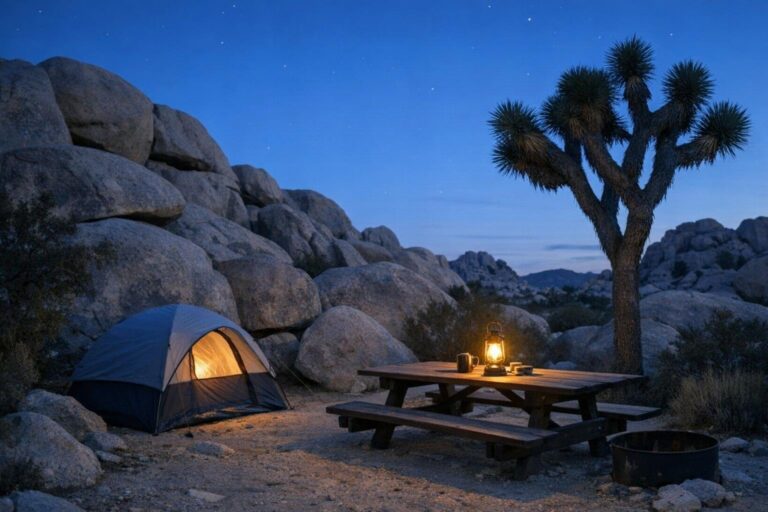
The park was designated an International Dark Sky Park in 2017. On a moonless night the Milky Way stands out clearly over the boulders, especially away from the western towns. The east side, toward Pinto Basin, is darker than the area near Yucca Valley.
- Plan around the moon: a new moon week gives the darkest sky.
- Use pullouts and parking areas only. Sleeping in a vehicle is not allowed at trailheads, roadsides or parking lots, so stargazing late means either a campsite or a drive back out.
- Bring layers. Even after a hot day, the high desert cools fast.
Summer heat and the best time to visit
Summer is the hard season. Daytime temperatures often pass 100°F and may not drop much below 75°F until early morning. Some campgrounds close or reduce service in summer, and the Black Rock Nature Center cuts its days.
The comfortable window runs through fall, winter and spring. Spring is the busiest time, when wildflowers bloom in good years; late fall and winter bring quieter roads and cold nights. Whatever the month:
- Carry more water than you think you need, for every person in the car.
- Fill the tank and stock up on food in town before you drive in.
- Do short walks early or late in the day, and rest in the shade at midday.
- Cell coverage is patchy, so download the park map before you lose signal.
A sample day in the park
- Early morning: enter at the West Entrance before the line builds, then walk the Hidden Valley loop while the light is low.
- Late morning: continue east on Park Boulevard, stopping at boulder pullouts and Skull Rock.
- Midday: head south on Pinto Basin Road toward the Cholla Cactus Garden and Cottonwood, a scenic drive you can do mostly from the air-conditioned car.
- Late afternoon: drive back north and out to Keys View for the evening light over the valley.
- After dark: stargaze from a campsite or a legal pullout before driving back to town.
How long to spend in Joshua Tree National Park
A single day covers the highlights: West Entrance in the morning, Hidden Valley and Skull Rock, Keys View for late light, then out through Twentynine Palms. If you can stay longer, two days let you add the drive south to the Cholla Cactus Garden and Cottonwood, a sunset walk among the boulders and a proper night under the stars.
Three days make sense for climbers and for anyone camping inside the park, which is the best way to catch both sunrise and the dark sky without driving back to town.
FAQ
Which entrance is best for a first visit?
The West Entrance, from the town of Joshua Tree, gets you to the Joshua tree forests and boulder areas fastest. Expect a line on spring weekends; arriving early or using the North Entrance helps.
Is one day enough for Joshua Tree?
One day is enough to drive Park Boulevard and see the main stops. Add a second day to reach the Colorado Desert side and stay for the night sky.
Can you visit Joshua Tree in summer?
Yes, but plan around the heat: drive and walk early or late, carry plenty of water and keep midday for shade or the car.
How much does it cost to enter?
$30 per private vehicle for seven days, or free with an annual pass. The America the Beautiful pass is accepted.