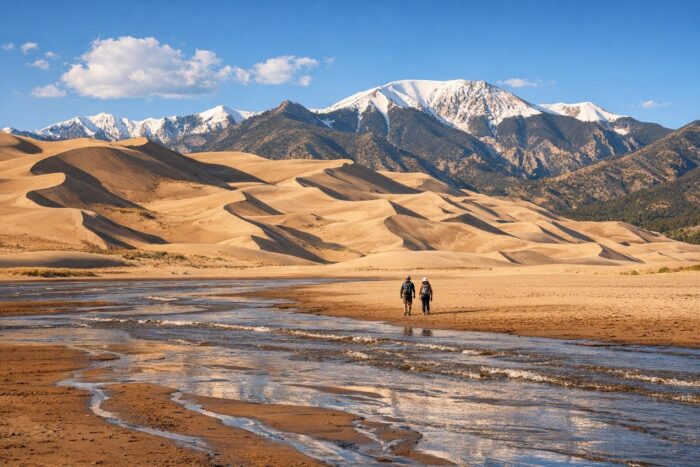
Great Sand Dunes National Park holds the tallest dunes in North America, piled against the Sangre de Cristo Mountains in south-central Colorado. The dunes rise about 750 feet above the valley floor, and Star Dune is the highest of them.
The park is remote, open year-round and easy to explore without a plan: you park, cross the creekbed and start climbing. What you need to get right is timing. The sand can burn bare feet in summer, and the famous spring creek does not show up every year.
Where Great Sand Dunes National Park is
The dunes sit on the eastern edge of the San Luis Valley, in Alamosa and Saguache counties. Alamosa, the nearest real town for fuel and groceries, is about 30 miles southwest by road. The visitor center is on State Highway 150, which branches off US-160 east of Alamosa.
The dunefield covers about 30 square miles, and the park and preserve together protect more than 149,000 acres, from grassland and wetlands up to alpine lakes and peaks. It was a national monument from 1932 and became a national park and preserve in September 2004.
The entrance fee is $25 per private vehicle. Visitors on foot or bike pay $15 per person, and those under 16 enter free. You can pay at the entrance station by card or cash, or buy a pass in advance on Recreation.gov.
Climbing the dunes
There are no marked trails on the sand. From the Dunes Parking Area you cross the wide Medano Creek bed and pick your own line up the ridges. Walking along a ridge crest is easier than going straight up a slope, where every step slides back.
The dunes are bigger than they look from the parking lot. Reaching the first high summits takes most visitors a couple of hours round trip, and Star Dune is a long, full-day outing over loose sand. Carry more water than you think you need, and turn back early if clouds build over the mountains: lightning strikes the exposed dunes in summer storms.
Sandboarding and sand sledding are allowed on the dunes. Bring a board or sled made for sand; snow sleds and plastic saucers barely slide.
Hot sand: when to go
On sunny summer afternoons the sand surface can reach about 150°F. That is hot enough to burn feet and paws, and it turns a dune hike into a slog. In summer, start at sunrise or go up in the evening, wear closed shoes, and avoid the midday hours entirely.
Spring and fall are the comfortable seasons. Winter brings cold nights and sometimes a dusting of snow on the dunes, which makes for striking photos and empty parking lots. Wind is the other factor: strong gusts in spring can sandblast skin and cameras.
The park is also an International Dark Sky Park, designated in 2019. On a clear, moonless night the Milky Way rises over the dunes, so it is worth staying after sunset.
Medano Creek in spring
Medano Creek is the reason many families visit in late spring. Snowmelt from the Sangre de Cristos spreads a shallow sheet of water across the sand at the base of the dunes. In an average year it reaches the Dunes Parking Area in April, peaks in late May or early June, and fades to an inch or two by late June.
At peak flow, the creek produces a “surge flow”: small waves roll down the sandy bed, and in good years kids float short distances on flat inflatables. It is a beach scene in the middle of the mountains.
It does not happen every year. In 2026, snowpack in the watershed was near record low, and the park reported that the creek never reached the main parking area that spring. If you are planning a spring trip around the creek, check the park’s Medano Creek updates in April before committing.
Medano Pass Primitive Road
For drivers with a real four-wheel-drive vehicle, Medano Pass Primitive Road continues north past the campground and over the mountains. It runs 22 miles, crosses Medano Creek nine times, includes about 4 miles of deep sand and tops out at 9,982 feet before dropping toward the Wet Mountain Valley. Only street-licensed 4WD vehicles, motorcycles and bicycles are allowed. A regular SUV without high clearance and low range should stay on the paved road.
Great Sand Dunes on a Colorado road trip
The dunes make an easy link between the mountains of northern Colorado and the canyon country of the southwest. A common loop starts in Denver with rocky mountain national park and Trail Ridge Road, then heads south through the San Luis Valley to the dunes before continuing west on US-160 toward Mesa Verde.
One night nearby is enough for most visitors: an evening on the sand, a sunrise climb, then back on the road before the heat. Stay two nights if you want to hike to Star Dune or drive the pass road. Want to compare the dunes with parks in other regions? Our region-by-region roundup of America’s standout parks lays out the best season and drive for each one.
Great Sand Dunes FAQ
How tall are the dunes at Great Sand Dunes National Park?
They rise about 750 feet above the valley floor. Star Dune is the tallest dune in North America.
When is Medano Creek flowing?
In an average year, from April to June, with the peak in late May or early June. Dry years can skip it entirely, as 2026 did at the main parking area.
Can you visit Great Sand Dunes in summer?
Yes, but go early or late. The sand surface can reach about 150°F in the afternoon, and thunderstorms bring lightning.
Is Great Sand Dunes open in winter?
Yes, the park is open year-round. Expect cold temperatures, few visitors and sometimes snow on the dunes.