Grand Teton National Park is the easiest add-on in the American West. It starts a short drive north of Jackson, Wyoming, its northern edge sits about 10 miles from Yellowstone, and the jagged Teton Range rises straight out of a flat valley floor, so the views start from the car window.
This guide covers the main roads, the viewpoints and lakes worth stopping for, how much time to give the park and the simplest way to chain it with its famous neighbor.
Grand Teton National Park, Wyoming, USA: the basics
Established in 1929 and expanded in 1950 when it absorbed Jackson Hole National Monument, the park now covers about 310,000 acres. It recorded 3,800,648 visits in 2025.
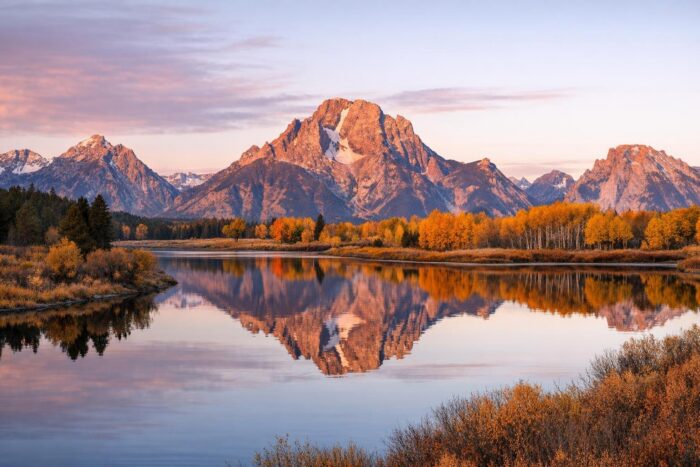
The centerpiece is the Grand Teton itself, 13,775 feet high and more than 7,000 feet above the valley of Jackson Hole. That valley runs about 55 miles north to south, and the Snake River crosses it after leaving Yellowstone and passing through Jackson Lake. The result is a landscape you can read in one glance: mountains to the west, sagebrush flats and river bends to the east, lakes strung along the base of the range.
Scenic drives through Teton National Park
Two parallel roads run north to south through the park and make a natural loop.
| Road | What you see | Season |
|---|---|---|
| Teton Park Road (inner road) | Runs close to the mountains past Jenny Lake turnoffs, Signal Mountain and Jackson Lake | Closed to cars November 1 to April 30 between Taggart Lake Trailhead and Signal Mountain Lodge |
| US-89/191 (outer road) | Wide views across the valley, the Snake River and its bends | Plowed for winter travel from Jackson to Flagg Ranch |
| Moose-Wilson Road | A narrow wooded road at the southwest corner of the park | Closed from November 1 until about mid-May |
Drive one road north and the other south and you cover the core of the park in a few hours. In winter, the closed part of Teton Park Road is groomed for skiing and snowshoeing from mid-December to mid-March, but the outer highway stays open, so the views remain accessible all year.
Viewpoints and lakes worth the stop
Along the outer road
- Oxbow Bend: a wetland curve of the Snake River near Moran, with Mount Moran reflected on calm mornings. A reliable spot for moose and waterbirds.
- Mormon Row: a historic homestead area east of the highway, best known for the John Moulton Barn framed by the Tetons.
- Snake River views: pullouts along the highway look across the river toward the full length of the range.
Along the inner road
- Jenny Lake: one of the lakes at the foot of the range. An easy hike from here reaches Hidden Falls, about 100 feet high.
- Jackson Lake: the largest lake in the park, about 15 miles long, 5 miles wide and 438 feet deep. A dam raised its level in the early 1900s.
- Signal Mountain: one of the isolated hills on the valley floor, with views over Jackson Lake and the valley.
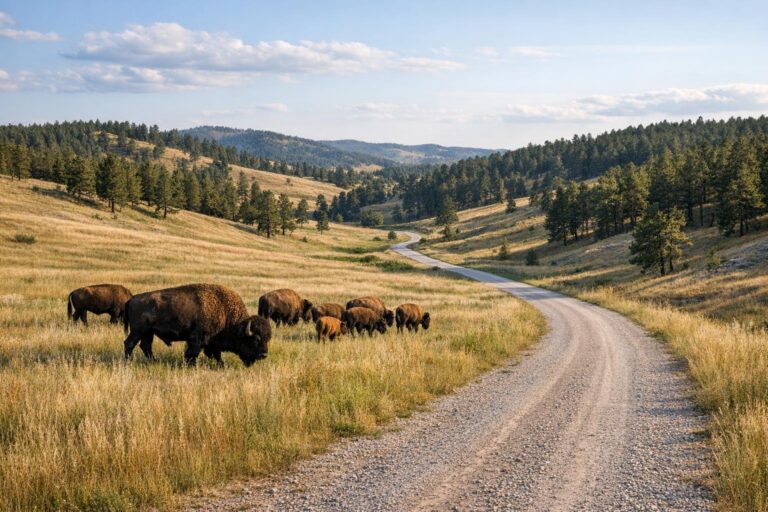
Wildlife is a big part of the drive. The park is home to about 61 mammal species, with elk in the thousands, plus moose, bison and pronghorn. Dawn and dusk along the river and the sagebrush flats give the best chances.
How long to spend in Grand Teton
A single day is enough for the scenic loop, a stop at Jenny Lake and sunset at a viewpoint. Two days is better: one for the drives and viewpoints, one for a real hike or time on the water. Photographers often want an extra sunrise, because the light on the range is at its best early.
| Time available | Suggested plan |
|---|---|
| Half a day | US-89/191 north with stops at Snake River pullouts and Oxbow Bend |
| One day | The full loop on both roads, Jenny Lake and Hidden Falls |
| Two days | Add Mormon Row at sunrise, Jackson Lake and a longer hike |
How to combine Grand Teton with Yellowstone
The two parks connect through the John D. Rockefeller Jr. Memorial Parkway, a protected corridor of about 23,700 acres that leads straight to Yellowstone’s South Entrance. There is no detour: you drive out of one park and into the other.
Seasons are the main constraint. Grand Teton’s outer road stays open in winter, but the road from the South Entrance into Yellowstone only opens to regular cars in May, and closes again at the end of October. Between those dates, a simple plan is two days in the Tetons followed by three or four days on Yellowstone’s Grand Loop, ending at the North or West Entrance.
Travelers starting from Salt Lake City or Denver often do it the other way around, entering Yellowstone first and finishing in Jackson. Either direction works. If you are building a longer trip across the Rockies and the West, our ranking of the parks that deserve a place on your itinerary helps decide what else to add.
Grand Teton National Park FAQ
How far is Grand Teton from Yellowstone?
About 10 miles separate the two parks, linked by the John D. Rockefeller Jr. Memorial Parkway. You can drive from one to the other in the same morning.
Is one day enough for Grand Teton?
One day covers the scenic loop and Jenny Lake. Two days give time for a hike and a sunrise at Oxbow Bend or Mormon Row.
Is Grand Teton open in winter?
Yes, partly. US-89/191 is plowed from Jackson to Flagg Ranch, but Teton Park Road is closed to cars from November 1 to April 30 and becomes a ski and snowshoe route.
What is the best viewpoint in Grand Teton?
Oxbow Bend and Mormon Row are the most famous, both best at sunrise. Jenny Lake is the top choice if you want to walk.