Yellowstone National Park is a road trip park at heart. Almost every famous sight, from Old Faithful to the Grand Canyon of the Yellowstone, sits on or just off one paved loop, and the hard part is not finding things to see but choosing an entrance, a pace and a season when the roads are actually open.
This guide covers where the park is, how the five entrances shape your route, how the Grand Loop Road is laid out, where to look for geysers and wildlife, how many days to plan, and what the 2026 road calendar looks like.
Where is Yellowstone National Park?
Yellowstone covers 2,219,791 acres, roughly 3,468 square miles, in the northwest corner of Wyoming. About 96% of the park lies in Wyoming, 3% in Montana and 1% in Idaho. It was established on March 1, 1872, which makes it the first national park in the United States, and it remains one of the busiest: the park counted 4,762,988 visits in 2025.
The park sits on a high volcanic plateau. Yellowstone Lake alone covers 87,040 acres at 7,733 feet above sea level, the largest high-elevation lake in North America. That altitude matters for drivers: snow can close passes in late spring and early fall, and nights are cold even in July.
Directly south, about 10 miles away, lies Grand Teton National Park, linked to Yellowstone by the John D. Rockefeller Jr. Memorial Parkway. Most travelers combine the two, and Yellowstone often features near the top of any list of the best national parks for a long drive through the Rockies.
The five entrances and how to choose
Yellowstone has five entrance stations. Which one you use depends on where your trip starts and where it goes next.
| Entrance | Gateway | Best for |
|---|---|---|
| North | Gardiner, Montana | Mammoth Hot Springs, the only road open year-round |
| Northeast | Cooke City and Silver Gate, Montana | Lamar Valley wildlife, arrival via the Beartooth Highway |
| West | West Yellowstone, Montana | Quickest access to the geyser basins and Old Faithful |
| East | Toward Cody, Wyoming | Yellowstone Lake via Sylvan Pass |
| South | Grand Teton National Park | Combining Yellowstone and the Tetons in one trip |
A practical rule: enter on one side and leave on another. Driving in from the south and out through the north, for example, lets you cover the whole loop once without doubling back, and it lines up neatly with a drive north into Montana afterward.
The Grand Loop Road, explained
The Grand Loop Road is the spine of any Yellowstone National Park itinerary. The system runs about 140 miles and links the park’s major junctions: Mammoth Hot Springs, Norris, Madison, Old Faithful, West Thumb, Lake and Fishing Bridge, Canyon and Tower. Entrance roads branch off it like spokes.
It works like a figure eight, with a cross road between Norris and Canyon that splits it into a northern and a southern half. That cross road is handy if you want to stay in one area and do the loop in two pieces.
- Southern half: Madison, the Firehole geyser basins, Old Faithful, Craig Pass over the Continental Divide, West Thumb, Yellowstone Lake and Hayden Valley.
- Northern half: Norris Geyser Basin, Mammoth Hot Springs, Tower-Roosevelt, Dunraven Pass near Mount Washburn and the Grand Canyon of the Yellowstone.
Distances look short on paper but the drive is slow. Speed limits are low, bison regularly stop traffic, and in 2026 the park also listed construction delays, including single-lane traffic at the Gardner River High Bridge near Mammoth and paving near the Yellowstone River Bridge east of Tower Junction. Budget far more time than the mileage suggests.
Geysers, hot springs and wildlife
Geyser country
Yellowstone holds about two-thirds of the world’s geysers. A 2011 study counted at least 1,283 geysers that have erupted in the park, with an average of 465 active in a given year. Old Faithful erupts roughly every 90 minutes, which makes it easy to plan around, and the boardwalks of the Upper Geyser Basin around it can fill a full morning.
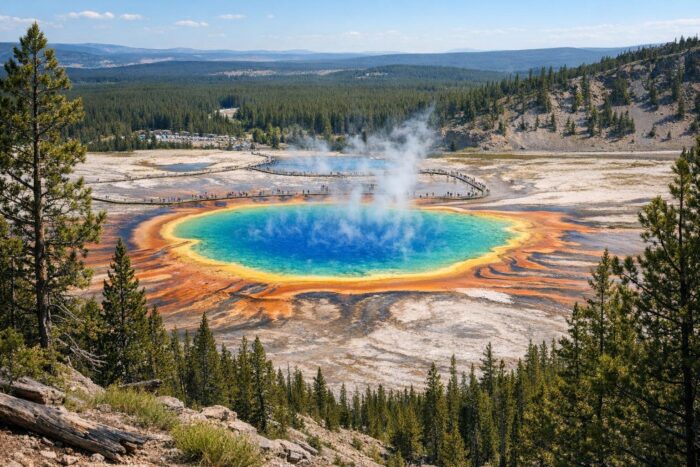
Nearby, Grand Prismatic Spring is the park’s most photographed hot spring. Norris Geyser Basin, to the north, is hotter and more acidic, and Mammoth Hot Springs offers travertine terraces rather than geysers. Stay on boardwalks everywhere: the crust around thermal features is thin and the water can be scalding.
Where to see animals
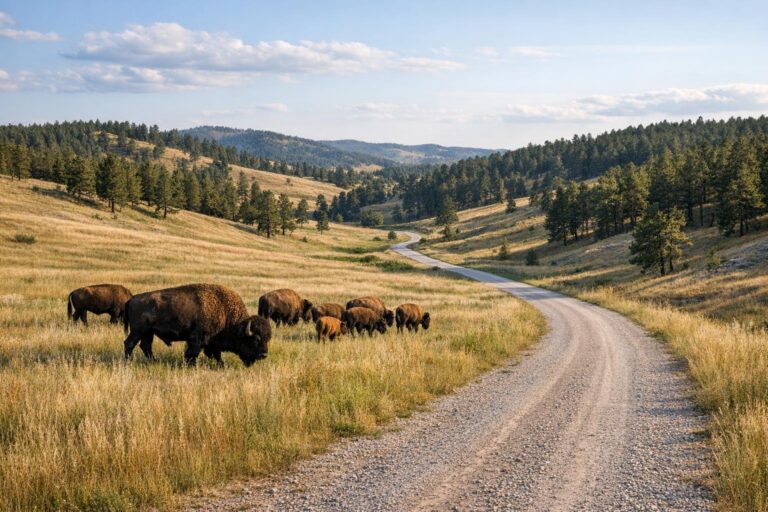
Two valleys do most of the work. Lamar Valley, on the road between Tower-Roosevelt and the Northeast Entrance, is the classic spot for bison herds and, with patience and binoculars, wolves. Hayden Valley, between Canyon and Lake, is another open stretch where bison and elk graze near the road. Early morning and evening are the most productive hours. Keep a long distance from every animal and never approach bison, however calm they look.
How many days do you need in Yellowstone?
Two full days is the minimum to drive the whole Grand Loop Road without rushing every stop. Three to four days is a better fit for most road trips.
- Day 1: Old Faithful and the Upper Geyser Basin, then Grand Prismatic Spring and the Firehole area.
- Day 2: Yellowstone Lake and West Thumb, then Hayden Valley in the evening.
- Day 3: Grand Canyon of the Yellowstone at Canyon, then north over Dunraven Pass to Tower.
- Day 4: Dawn in Lamar Valley, then Mammoth Hot Springs and Norris on the way out.
Splitting your nights between two bases, one in the south near the geyser basins and one in the north, cuts down on long daily drives. Add one or two days if you are also covering Grand Teton.
When are Yellowstone’s roads open?
Yellowstone’s summer road season is short and staggered. For 2026, the park projected these dates for regular vehicles:
| Road segment | Projected 2026 season |
|---|---|
| North Entrance to Northeast Entrance | Open year-round |
| West Entrance to Madison, Old Faithful and Norris; Mammoth to Norris to Canyon | April 17 to October 31 |
| East Entrance to Fishing Bridge (Sylvan Pass); Canyon to Bridge Bay | May 1 to October 31 |
| South Entrance to West Thumb; West Thumb to Old Faithful (Craig Pass) and Lake Village | May 8 to October 31 |
| Canyon to Tower Fall (Dunraven Pass) | May 22 to October 12, sometimes later if weather allows |
The Beartooth Highway (US-212) and the Chief Joseph Scenic Byway (WY-296) outside the park were projected for May 22 to October 12. Storms move these dates every year: in April 2026 a winter storm pushed the spring opening from 8 a.m. to noon. Check the park’s live road status before you set out.
From early November to late April most roads are closed to regular cars. Between December 15, 2026 and March 15, 2027 the West, South and East entrances and the groomed interior roads open only to guided snowmobiles and snowcoaches. The northern road from Gardiner to Cooke City is the one route you can drive in winter, and it runs right through Lamar Valley.
Best time for a road trip
Mid-June to mid-September gives you every road open and long days, with the biggest crowds in July and August. Late May and September are quieter and good for wildlife, but snow can still close a pass for a day. October is a gamble: crisp and empty, with roads shutting at the end of the month.
Map of Yellowstone National Park by area
A simple mental map makes planning easier. Think of the park as five sectors around the loop:
- Geyser Country (southwest): Madison, Firehole, Midway and Upper Geyser Basins, Old Faithful.
- Lake Country (southeast): West Thumb, Yellowstone Lake, Fishing Bridge, the road east to Sylvan Pass.
- Canyon Country (center east): Grand Canyon of the Yellowstone, Hayden Valley.
- Roosevelt Country (northeast): Tower Fall, Lamar Valley, the Northeast Entrance.
- Mammoth Country (northwest): Mammoth Hot Springs, Norris, the North Entrance.
The official park map from the National Park Service shows these areas, the junctions and every entrance road. Download it before you go: cell coverage is patchy across much of the park.
Yellowstone National Park FAQ
What state is Yellowstone National Park in?
Mostly Wyoming. About 96% of the park is in Wyoming, with small slices in Montana (3%) and Idaho (1%). Three of the five entrances open from Montana towns.
Can you drive through Yellowstone in one day?
You can drive the Grand Loop Road in a day, but you will spend most of it in the car. Plan at least two days, ideally three or four.
Which Yellowstone entrance is best?
The West Entrance is fastest for Old Faithful and the geysers, the North and Northeast are best for wildlife, and the South Entrance is the natural choice if you are coming from Grand Teton.
Is Yellowstone open in winter?
Partly. The road from the North Entrance to the Northeast Entrance stays open to cars all year. The rest of the park opens in winter only to guided snowmobile and snowcoach tours.