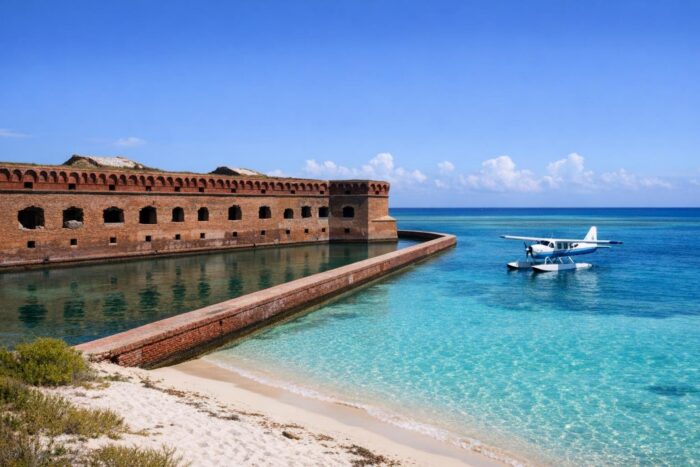
Dry Tortugas National Park is the road trip destination you cannot drive to. It lies about 70 miles west of Key West, beyond the end of the Overseas Highway, and the only ways in are by boat or seaplane. What waits at the other end is a massive 19th-century fort rising out of turquoise water, coral reefs a few strokes from the beach and some of the best bird watching in North America.
Here is how to get there, what it costs, where to sleep if you stay overnight and when to go.
What you will find at Dry Tortugas National Park
The park covers seven small islands and the surrounding waters, which make up almost all of its area. Ferry and seaplane visitors land on Garden Key, home to Fort Jefferson and the park’s few facilities.
Fort Jefferson is the centerpiece. Built over nearly thirty years, from 1846 to 1875, it is one of the largest forts ever built and was never finished nor fully armed. It guarded a strategic anchorage on one of the world’s busiest shipping lanes, served as a military prison in the Civil War era, and later became a coaling station; the USS Maine sailed from the Tortugas in 1898 on its way to Havana. You can walk the casemates, climb to the top of the walls and follow the moat wall around the outside.
The water is the other attraction. Snorkelers find coral and tropical fish along the moat wall and around the beaches, and the islands are a major stop for migrating and nesting seabirds in spring.
Getting there from Key West: ferry, seaplane or boat
Most visitors start the trip with a drive down the Keys. Once in Key West, you have four options, all of which need booking well ahead in the busy season:
| Option | How it works | Good to know |
|---|---|---|
| Ferry | Daily high-speed catamaran service from Key West, for day trips and campers | Limited seats; the ticket includes the park entrance fee |
| Seaplane | Half-day or full-day flights landing at Garden Key | Fastest and most scenic, but no transport for campers and their gear |
| Private boat | Your own vessel, at least 70 miles of open water each way | Buy a digital entrance pass in advance on Recreation.gov |
| Permitted charter | Licensed guides for fishing, diving or wildlife trips | Can reach parts of the park beyond Garden Key |
The park itself has very limited services: no food for sale, no fresh water for campers and little or no cell coverage. Prepare in Key West before you leave.
Driving the Overseas Highway to the end of the road
For road trippers, Dry Tortugas is the natural finale of a drive down the Overseas Highway, which hops from key to key over more than 40 bridges between the mainland and Key West. Most people spend a night or two in Key West before the crossing, since the daily ferry leaves Key West in the morning.
It pairs well with the mainland parks on the way down. Spend a day or two in Everglades National Park near Homestead, add Biscayne’s bay and reefs, then drive the Keys and finish at Fort Jefferson: three national parks in about a week, all in South Florida.
Fees and reservations
- Entrance fee: $15 per person, valid for seven consecutive days. Visitors 15 and under are free.
- Ferry passengers: the fee is included in the ferry ticket.
- Private boaters and private seaplanes: buy a digital entrance pass on Recreation.gov before arrival.
- America the Beautiful pass: accepted for the entrance fee; the $80 resident annual pass covers the passholder plus three adults where fees are charged per person.
The biggest constraint is not the fee but the transport. Seats on the ferry are limited, and the park recommends booking months ahead, especially for the winter holidays and the winter season.
Camping on Garden Key
Staying overnight on Garden Key is one of the most memorable camping experiences in the national park system: the fort to yourself after the day boats leave, and a sky with almost no light pollution.
- Sites: eight regular campsites, first come, first served, each for up to six people and three tents, plus an overflow area. Only the large group site (10 to 20 people) can be reserved.
- Cost: $15 per night per regular site, $30 for the group site, paid separately from transport.
- Supplies: bring everything, including tent, fresh water, fuel, ice and food, and carry all trash out.
- Getting there: by ferry, private boat or permitted guide only. The seaplane cannot carry camping gear.
Best time to visit Dry Tortugas
Winter and spring are the most popular seasons, with calmer heat and drier weather, which is exactly why ferry seats sell out. Spring also brings the seabird nesting season. Summer is hot and humid, but the water is warm for snorkeling. The Atlantic hurricane season runs from June through November, and crossings can be cancelled when weather threatens, so keep a buffer day in Key West if your trip falls in that window.
Dry Tortugas is small and remote, but it deserves its place on any list of the parks worth building an American road trip around, precisely because it caps the road with a journey across open sea.
Dry Tortugas National Park FAQ
Can you drive to Dry Tortugas National Park?
No. There are no roads or bridges. You drive to Key West, then continue by ferry, seaplane or boat for about 70 miles.
Is a day trip enough?
For most visitors, yes. A day trip leaves several hours on Garden Key, enough to tour Fort Jefferson and snorkel. Camp overnight if you want the island without the crowds.
Do I need to pay the entrance fee if I take the ferry?
No separate payment is needed: the $15 entrance fee is included in the ferry ticket.
Can I bring camping gear on the seaplane?
No. Campers must use the ferry, a private boat or a permitted guide.