Badlands National Park, in southwestern South Dakota, is one of the easiest national parks to fit into a cross-country drive. A 40-mile paved road leaves Interstate 90, threads through eroded buttes and grasslands, and rejoins the interstate, so you can see the heart of the park without a detour of more than a few hours.
This guide covers the Badlands Loop Road, the wildlife you are likely to see, how long to stay and how the park fits into a longer trip west across the Plains.
Badlands National Park at a glance
The park covers 242,756 acres. It became a national monument in 1939 and was redesignated a national park on November 10, 1978. Rapid City is the nearest city.
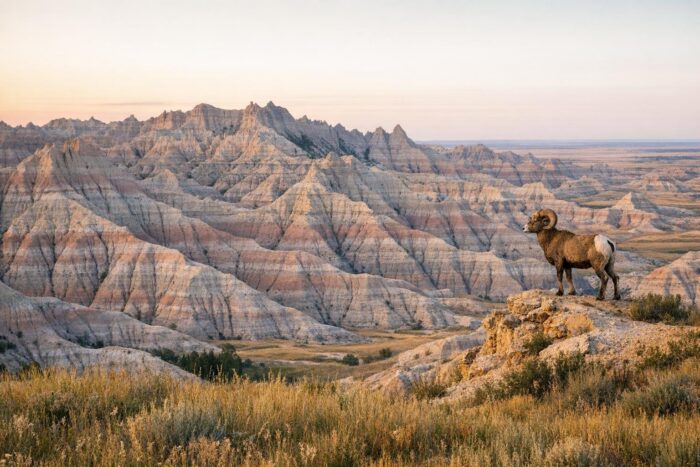
The landscape is the draw: banded spires, ridges and gullies cut into soft sediment, with mixed-grass prairie on top. Those layers hold one of the richest deposits of Oligocene mammal fossils known, from around 33 million years ago. The park has two parts. The North Unit holds the main roads and most visitor services. The South Unit, about 133,300 acres, is co-managed with the Oglala Lakota and has no road running through it.
Driving the Badlands Loop Road
The Badlands Loop Road is South Dakota Highway 240. It runs about 40 miles between two I-90 exits: exit 110 at Wall on the west and exit 131 on the east. You can drive it in either direction and be back on the interstate at the other end.
| Point on the route | What it is |
|---|---|
| Wall (I-90 exit 110) | Western end, the town at the edge of the park |
| Pinnacles Entrance | Park entrance station on the western half of the road |
| Cedar Pass | Park headquarters area, Ben Reifel Visitor Center and Cedar Pass Campground |
| Northeast Entrance | Park entrance station near the eastern end |
| I-90 exit 131 | Eastern end, back on the interstate |
Overlooks and short boardwalk trails line the road, and almost every pullout is worth a stop. The Ben Reifel Visitor Center, built in the late 1950s, has museum exhibits and rangers who can tell you about current conditions and wildlife sightings.
Sage Creek Rim Road
The park’s other main road in the North Unit is Sage Creek Rim Road, which heads west from the Loop Road near the Pinnacles area along the edge of the Badlands Wilderness. It leads to Sage Creek Campground, the park’s second campground, and to open prairie where wildlife is easier to find than along the busier loop.
Wildlife in Badlands National Park
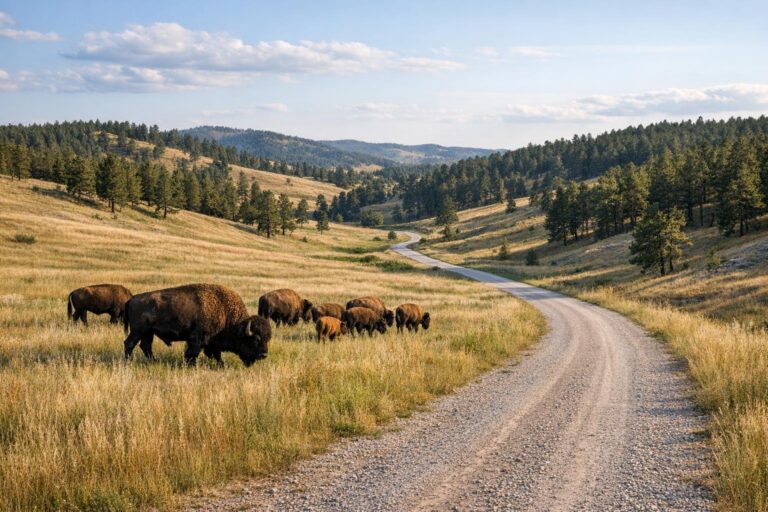
- Bison: 50 bison were brought from Theodore Roosevelt National Park in 1963, and the herd has grown to more than 1,200 animals. They roam the prairie in the western part of the North Unit.
- Bighorn sheep: often seen on the steep slopes and ridges near the road.
- Prairie dogs: black-tailed prairie dog colonies are easy to spot in the grasslands along Sage Creek Rim Road.
- Black-footed ferrets: one of North America’s rarest mammals, reintroduced in the Badlands Wilderness. They are nocturnal and rarely seen.
Pronghorn and coyotes also live here. Early morning and late afternoon are the best times for wildlife, and the softer light shows off the colors of the rock. Stay in your car or keep a wide distance around bison.
How long to spend in the Badlands
Most road trippers give the park half a day to one day. Driving the Loop Road with stops at overlooks and a short walk takes a few hours. Adding Sage Creek Rim Road for wildlife, plus sunset or sunrise over the formations, fills a full day.
Staying overnight is worth it if you can. Sunrise and sunset light up the bands of color in the rock, and the night skies over the prairie are dark. Cedar Pass and Sage Creek are the two campgrounds inside the park.
A stop on the road to Yellowstone via I-90
The Badlands sit right on I-90, the main east-west interstate across the northern Plains, which is why so many travelers heading west build them into a Yellowstone road trip. Drive the Loop Road from exit 131 to Wall, then keep going west on I-90.
From there you have two common options. The first stays on I-90 into Montana and turns south on US-89 to Gardiner and Yellowstone’s North Entrance. The second leaves the interstate in Wyoming and heads toward Cody and the East Entrance, which is a scenic approach over Sylvan Pass. Both are long days of driving, so most people add a night in the Black Hills, near Rapid City, and another in Wyoming or Montana.
The Black Hills are worth more than a quick night: Wind Cave National Park, Jewel Cave National Monument and Mount Rushmore National Memorial are all there. If you are still choosing which parks to fit into a cross-country route, our list of the parks that make the best road trip destinations can help you decide.
Badlands National Park FAQ
How long is the Badlands Loop Road?
About 40 miles. It is South Dakota Highway 240, running between I-90 exit 110 at Wall and exit 131 to the east.
Can you see the Badlands in one day?
Yes. Half a day covers the Loop Road, and a full day lets you add Sage Creek Rim Road and a sunset.
Where can you see bison in Badlands National Park?
Mostly in the prairie of the western North Unit, around Sage Creek Rim Road. The herd numbers more than 1,200 animals.
Is Badlands National Park on the way to Yellowstone?
Yes, if you are coming from the east on I-90. The Loop Road leaves and rejoins the interstate, so it adds only a few hours to the drive.