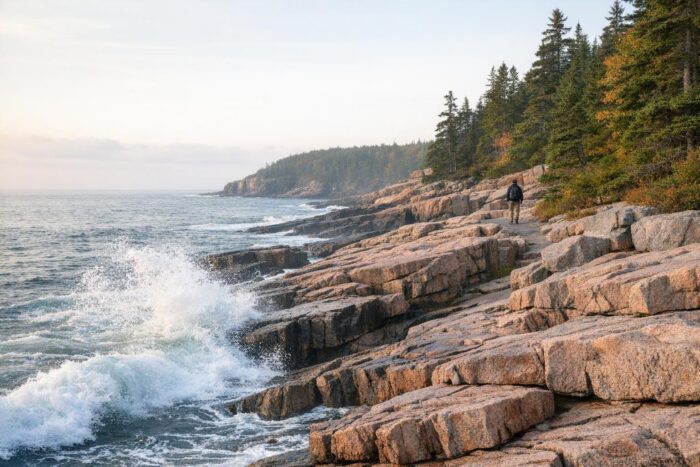
Acadia National Park is where New England’s rocky coast meets granite mountains. Most of it sits on Mount Desert Island in Maine, and nearly everything visitors come for, from Sand Beach to the summit of Cadillac Mountain, lines a single scenic road you can drive in an afternoon and explore for days.
This guide covers how to drive the Park Loop Road, how the Cadillac Mountain vehicle reservation works, when to come for fall color, what the park costs in 2026 and how Acadia fits into a wider road trip through New England.
Where Acadia National Park is and how to get there
Acadia lies on the central Maine coast, about five hours’ drive north of Boston. The usual route follows I-95 to Bangor or the coast road to Ellsworth, then Route 3 onto Mount Desert Island. Bar Harbor, the main gateway town, sits right next to the Hulls Cove entrance and visitor center.
The park has three separate sections:
- Mount Desert Island: the main part, with the Park Loop Road, Cadillac Mountain, Jordan Pond and most trails.
- Schoodic Peninsula: the only section on the mainland, about an hour’s drive from Bar Harbor, quieter and open year-round on its loop road.
- Isle au Haut: an island reached only by mail boat, for hikers who want solitude.
Hulls Cove Visitor Center was open from May 1 to October 31 in 2026. Outside that window, information is limited, so plan ahead if you come in the shoulder season.
Driving the Park Loop Road
The Park Loop Road is the backbone of any Acadia visit. It forms a loop of about 27 miles from Hulls Cove, with a long one-way section along the ocean where parking in the right lane is allowed in marked stretches. The road and the park’s other paved roads were open from April 15 to December 1 in 2026; in winter, most of the loop closes to cars.
Driving clockwise from Hulls Cove, the main stops come in this order:
- Sieur de Monts: a nature center, gardens and the start of several trails.
- Sand Beach: a small beach in a granite cove, with cold water even in August.
- Thunder Hole: a narrow inlet where waves boom into a rock chamber, loudest about two hours before high tide.
- Otter Cliff: pink granite cliffs dropping straight into the Atlantic.
- Jordan Pond: a clear glacial lake framed by the rounded mountains known as the Bubbles.
- Cadillac Mountain: the summit road branches off the loop near the end.
Parking at Sand Beach, Thunder Hole and Jordan Pond fills early in summer. Starting before 9 a.m. or driving the loop in late afternoon makes a big difference. Vehicles over 21 feet, RVs and trailers are better left in town for the Cadillac summit, where they are not allowed.
Cadillac Mountain and the sunrise reservation
Cadillac Mountain rises to 1,530 feet, a modest height that still makes it a landmark on the Atlantic coast. From October 7 to March 6, it is the first place in the United States to see the sunrise, which is why so many people want to be on top at dawn.
To control crowds, the park requires a vehicle reservation to drive the 3.5-mile Cadillac Summit Road during the busy season. In 2026 it applied from May 20 to October 25. Here is how it works:
- Cost: $6 per vehicle, sold online only through Recreation.gov, never at the park.
- Two types: Sunrise slots with a 90-minute entry window, and Daytime slots with a 30-minute window.
- Release: 30 percent of slots open 90 days ahead and the remaining 70 percent open two days ahead, both at 10 a.m. Eastern.
- Entrance pass: the reservation does not replace the park entrance pass; you need both.
Sunrise slots sell out fast, especially in summer and during fall color. If you miss them, the two-day release is your best second chance. You can also hike up the North Ridge or South Ridge trails without a vehicle reservation.
Acadia National Park fees in 2026
| Pass | Price | What it covers |
|---|---|---|
| Private vehicle | $35 | Vehicle and all passengers, 7 days |
| Motorcycle | $30 | Up to 2 motorcycles, 7 days |
| Per person | $20 | Visitors on foot or bike, 7 days |
| Acadia annual pass | $70 | 12 months, U.S. citizens and residents |
| Cadillac Summit Road reservation | $6 | One vehicle, one time slot |
An entrance pass is required year-round. Since 2026, visitors who are not U.S. residents and are 16 or older pay an additional $100 per person at Acadia unless they hold an annual or America the Beautiful pass. The $80 America the Beautiful pass for U.S. residents covers Acadia and other federal sites for a year, which makes sense if you plan several parks.
When to visit: summer, fall color and the off-season
Summer (late June to August) is warm, long and busy. Everything is open, the carriage roads are perfect for cycling and the ocean is still too cold for most swimmers. Book lodging early.
Fall (September to mid-October) is many travelers’ favorite season. Maples, birches and blueberry barrens turn red and gold, usually peaking around early to mid-October, and crowds thin after Labor Day except on foliage weekends. Cadillac reservations remained in place until October 25 in 2026.
Late fall to spring is quiet. Most of the Park Loop Road closes to cars from December 1 to April 15, but walkers, cross-country skiers and snowshoers use it, and the Schoodic loop stays open.
How many days to spend in Acadia
- One day: drive the Park Loop Road, walk around Jordan Pond and catch sunset or sunrise on Cadillac.
- Two to three days: add a hike such as the Beehive or the Jordan Pond path, ride a stretch of the 45 miles of historic carriage roads built by John D. Rockefeller Jr., and explore the quieter western side of the island.
- Four days or more: add the Schoodic Peninsula and a boat trip to the outer islands.
Acadia on a New England road trip
Acadia is the only national park in New England, and it works best as the high point of a coastal drive. A classic one-week loop starts in Boston, follows the Maine coast north through Portland and the lighthouses of midcoast Maine, spends two or three nights near Mount Desert Island, then returns through inland Maine or New Hampshire’s White Mountains, where the Kancamagus Highway is a fall favorite.
If you are collecting parks, Acadia is far from the others. It ranks among America’s most beautiful national parks for its mix of sea and summit, but it sits far from every other national park: Shenandoah, the closest by road, is a long two-day drive away. Treat it as a destination in itself rather than a stop on a multi-park route.
A few practical points for the drive: traffic on Route 3 into Bar Harbor can be slow on summer weekends, cell coverage drops in parts of the park, and the gas stations are in the towns rather than inside Acadia.
Acadia National Park FAQ
Do I need a reservation to visit Acadia?
Not to enter the park. You only need a reservation to drive up Cadillac Summit Road during the reservation season, which ran from May 20 to October 25 in 2026. An entrance pass is always required.
Can I see the sunrise on Cadillac Mountain without a reservation?
Yes, on foot. Several trails reach the summit, including the North Ridge and South Ridge trails; bring a headlamp for a dawn ascent. Outside the reservation season, you can drive up when the road is open.
When is fall foliage in Acadia?
Color usually peaks around early to mid-October, depending on the year’s weather.
Is Acadia worth visiting in winter?
For quiet walks and snowy coast views, yes, but most of the Park Loop Road is closed to cars from December 1 to April 15 and services are minimal.