Historic Route 66 is the name given today to what remains of US Highway 66, the 2,448-mile road that linked Chicago to Los Angeles and Santa Monica from 1926 until it was decommissioned in 1985. Much of it survives as local roads, state highways and a National Scenic Byway, signed with brown “Historic Route 66” markers.
In 2026 the road turns 100. Here is what Route 66 is, why it became the most famous highway in America, how it nearly disappeared, and how the centennial is being celebrated along the way.
What is Route 66?
Route 66 was one of the original highways of the US numbered highway system created in 1926. Instead of running in a straight line, it connected hundreds of rural towns, following a diagonal path from Chicago to St. Louis, through Oklahoma and the Southwest, and on to Southern California. It crossed eight states: Illinois, Missouri, Kansas, Oklahoma, Texas, New Mexico, Arizona and California.
Oklahoma highway official Cyrus Avery was among its strongest promoters, and the US Highway 66 Association later marketed it as the shortest, best and most scenic route from Chicago through St. Louis to Los Angeles. By 1938 it had become the first US highway to be fully paved.
A short history of the old Route 66
| Year | What happened |
|---|---|
| 1926 | The number 66 is assigned on April 30; the highway is commissioned on November 11. |
| 1930s | Dust Bowl migrants head west on the road; it is extended to Santa Monica and fully paved by 1938. |
| 1939 | John Steinbeck calls it “the mother road” in The Grapes of Wrath. |
| 1940s | The road moves troops and supplies during World War II; Nat King Cole’s recording of “Route 66” is released in 1946. |
| 1950s | Car ownership booms and families drive it on vacation; the 1956 Interstate Highway Act starts its replacement. |
| 1984 | Williams, Arizona, becomes the last town bypassed by I-40. |
| 1985 | US 66 is removed from the federal highway system. |
| 1990s | Congress passes the Route 66 Study Act and later creates a National Park Service preservation program for the corridor. |
| 2026 | The centennial year. |
Why is Route 66 famous?
Plenty of old highways were replaced by interstates. Few became legends. Route 66 did for several reasons that stacked up over time.
It carried a national story
During the Depression, families fleeing the Dust Bowl drove it toward California, and Steinbeck’s novel fixed that exodus in American memory. During World War II, the road moved soldiers and workers west. After the war, it carried millions of vacationers toward the Grand Canyon and the Pacific.
It built its own roadside culture
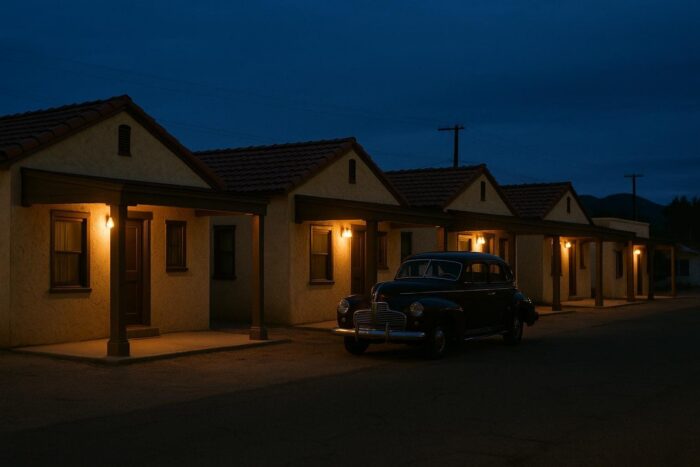
Because the road ran through the middle of small towns, businesses competed for drivers’ attention. That produced neon signs, motor courts like the Blue Swallow Motel in Tucumcari and the Wigwam Motel in Holbrook, diners, gas stations and giant roadside figures. Much of that architecture still stands.
Pop culture kept it alive
Bobby Troup’s song “(Get Your Kicks on) Route 66”, first made popular by Nat King Cole in 1946, turned the itinerary into a lyric. Much more recently came the animated film Cars, whose characters now greet visitors at Cars on the Route in Galena, Kansas.
How Route 66 was decommissioned
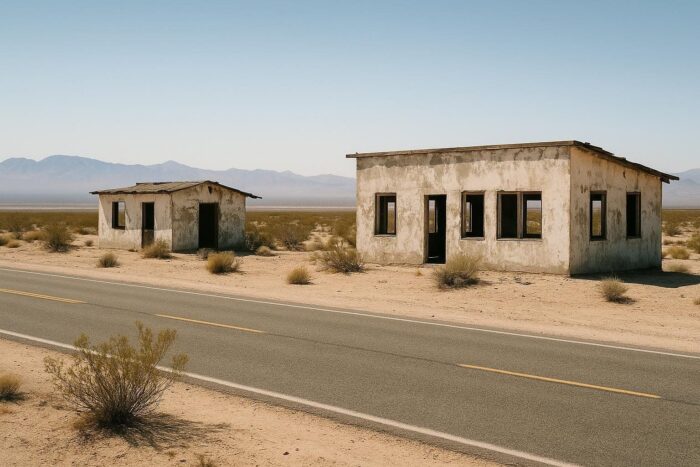
The interstates did what they were designed to do: move traffic faster. Over about three decades, I-55, I-44, I-40, I-15 and I-10 replaced the old road section by section. Towns that had lived off passing traffic were bypassed, and some, like Amboy in the Mojave, emptied out. When I-40 bypassed Williams, Arizona, in 1984, the last section of US 66 was gone, and the highway was officially removed from the system in 1985.
Old Route 66 did not vanish, though. The pavement stayed, mostly handed over to states and counties. Local associations, business owners and preservationists put up signs, restored buildings and published guides for travelers who wanted to follow the old alignment.
Historic Route 66 National Scenic Byway
Today, portions of the road in Illinois, Missouri, Oklahoma, New Mexico and Arizona are designated together as a National Scenic Byway under the name “Historic Route 66”. In California, the section between Needles and Barstow was named a National Scenic Byway in February 2021.
The designation does not change how you drive the road, but it supports signage, preservation and promotion. In practice it means that long segments of historic Route 66 are marked, maintained and meant to be driven, often right next to the interstate that replaced them.
The Route 66 centennial in 2026
National celebrations officially began on April 30, 2026, exactly 100 years after the number 66 was assigned. Events run through the year in every Route 66 state:
- In Chicago, Navy Pier was dedicated on March 25, 2026, as a new symbolic starting point, linked “pier to pier” with Santa Monica.
- The US Postal Service issued Forever stamps for the anniversary.
- Arizona’s Route 66 Fun Run, the oldest celebration of the road, ran from Seligman on May 1 to 3, 2026.
- In Catoosa, Oklahoma, a new Blue Whale Visitor Center opened on May 30, 2026.
- Amarillo hosts the official Texas Route 66 Festival, and the 2026 New Mexico State Fair celebrated the anniversary in September.
If you want to experience the road during its hundredth year, a Route 66 road trip this fall still catches the tail end of the celebrations. For other legendary drives to compare it with, see our complete USA road trip guide.
Historic Route 66 FAQ
Is Route 66 still a real highway?
Not as a US highway. It was decommissioned in 1985, but large parts remain as state and local roads signed as Historic Route 66.
Why is it called the Mother Road?
The nickname comes from John Steinbeck’s 1939 novel The Grapes of Wrath. It was also promoted as the “Main Street of America” and known as the Will Rogers Highway.
When is the Route 66 centennial?
In 2026. The number was assigned on April 30, 1926, and the highway was commissioned on November 11, 1926.
Can you still drive old Route 66?
Yes. Most of the route can be followed today, using the old road where it survives and the interstate where it does not.